
how UWU members stand together (and win) in the fight for job security
“I was grateful for Union support in this time. Without the Union I think we would have no hope!”
Solidarity is standing up and speaking out even when you’re not directly affected. UWU members and delegates show solidarity every day. We back each other up, and we stand together to ensure everyone is treated fairly. That’s what Crown Melbourne members are doing right now – fighting for fair jobs for future workers. And it’s why eleven school cleaners in the ACT now have permanent jobs – delegates heard that 11 school cleaners would soon be unemployed, and though their own jobs were safe, they spoke out to help their union comrades. This is what it means to be union.
When eleven school cleaning members in the ACT were told their jobs were coming to an end, delegates sprang into action! The eleven UWU members had been employed on fixed-term contracts, which had been extended, but they were told their contracts would expire in late January 2026 and would not be renewed. However, Delegates knew that the work of the 11 members would still be required into the future and that there were sufficient vacant permanent positions to offer the 11 members permanent jobs. The Department, however, disagreed.
Delegates advocated for members by writing to the Education Minister and worked with their local organiser, the UWU Vice President Lyndal Ryan, and the Union’s industrial officers (our resident legal experts), to fight for their union comrades.
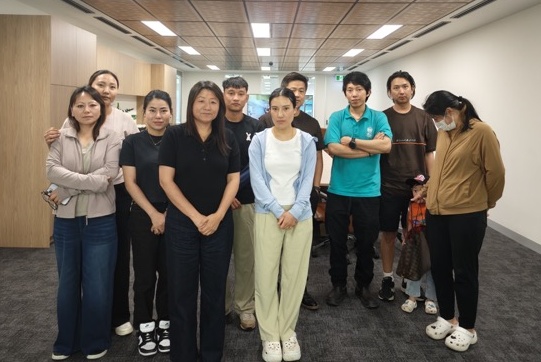
UWU then took the matter to the Fair Work Commission, disputing the use of the fixed-term contracts in the first place, while also raising concerns about inadequate workplace consultation in relation to the total number of school cleaners required. The Union also made formal requests on behalf of the members for conversion to ongoing employment. After two appearances in the Fair Work Commission, some progress was made – some members were offered jobs. However, it looked like only 3 of the 11 jobs would be saved. Just when hope seemed lost, last-minute discussions between the Department and the Union led to all eleven members keeping their jobs and moving to permanent employment.
Leko Leko, one of the school cleaning delegates, said,
“Being an UWU delegate, one of our members, Moon, told me that her contract is going to finish soon and worried about becoming jobless after that. As soon as she raised the issue, the discussion was brought to the Union. We delegates wrote emails to Education minister for support and finally they are with us. We as union always take care of our members as much as family.”
And Moon said,
“With our union, we had gone to the Fair Work Commission. But even in the Fair Work Commission they were saying that there was no vacancies and they were going to terminate us on 29 January. On our last day, the office was telling us they wanted us to return our uniform and pass and sign an end of contract paperwork. I had worked for school cleaning for 1 year already and I was really sad that I was going to be terminated. Then at about 7pm we all got a message from the Union that the Department was going to make all 11 union members permanent and I just said, “Oh my god, it’s an amazing news.” I was grateful for Union support in this time. Without the Union I think we would have no hope! I am really happy now that I am permanent.”
Congratulations to the members and delegates who stood together to save these jobs. This is what we mean when we talk about solidarity – showing up for our union brothers and sisters. And this story is just one example; members and delegates work every day to lift others up. Solidarity forever!
AI regulation built into health & safety reforms
Last month the Work Health and Safety Digital Systems Bill passed through NSW parliament. This is an important moment for workers’ health and safety rights because this bill strengthens protections against unsafe Artificial Intelligence (AI) and algorithm driven practices and holds employers accountable when AI systems harm workers.
Thanks to our UWU Homecare delegate and Woolies Health and Safety Reps (HSRs) who shared their stories about Workplace Health and Safety (WHS) risks with AI rostering, digital performance management and surveillance, NSW has set a breakthrough standard for workplace safety in the digital age.
While this bill makes changes to the NSW WHS Act, it’s critical for all workers. Our Workplace Health and Safety laws are state and territory based, this reform will serve as example for WHS laws to keep up with digital impacts on our work and address the real risks of digital systems and our workplace health and safety.
Under the new laws, employers must make sure digital systems such as algorithms, AI and online platforms do not risk the health and safety of workers. Employers, by law, now have to check whether their digital systems (like monitoring, AI rosters, surveillance, performance management) can cause physical and/or psychosocial WHS hazards and risks like excessive workloads, unreasonable performance metrics or discriminate against workers.
Unions and HSRs in NSW now have the power to require “reasonable assistance” to access and inspect digital systems with 48 hours’ notice. That means your union or HSR can look at how data is used, how decisions are made, how digital systems impact our work, and where our data is stored.

Crown Melbourne Members Fighting for a Fair Deal

UWU members at Crown Melbourne are in a tough fight with their employer. Members have been taking strike action over some of the casino’s busiest periods, like the New Year celebration period, Valentines Day, and Lunar New Year. This followed members and workers at the casino overwhelmingly voting no to Crown’s offer in December 2025. Crown’s proposal includes a divisive two-tier wage system that would see new staff being paid up to 32% less than current staff for the exact same work.
Not only would Crown’s proposed two-tier wage system be incredibly unfair for new staff, current part time and casual workers have credible concerns over the possibility of losing hours and jobs to newer, cheaper workers should Crown get their way.
Members are resolved to protect wages and conditions for both current and future Crown employees. One member Nick pointed out,
“This is one of the most profitable hospitality companies in Australia, and they’re saying they can’t pay workers a reasonable rate increase.”
While another UWU Crown member, Sam, warned,
“You’re not coming to the table, you’re not giving us a fair deal, and these workers are people who work around the clock every day. Crown can expect a lot of disruption.”
Educators win reforms to improve child safety and address understaffing
A staffing loophole that allowed unsafe understaffing in early education and care has been closed by the Albanese Labor Government – a win for educators who campaigned vigorously for the change.
The loophole, occurring through misuse of the so-called “Under The Roof Ratio”, was highlighted in a survey of thousands of educators last year, with 83 per cent agreeing the practice compromised the safety and wellbeing of children.
The same survey found 77 per cent of educators reported being understaffed in their rooms on a weekly basis, often due to misuse of the staffing loophole.
United Workers Union welcomes Friday’s statement by Education Minister Jason Clare and Jess Walsh – both recognising the impact of the staffing loophole, and ending the resulting unsafe staffing practices.
“It is great to see written in black-and-white that bad business practices – such as using under the roof ratios to mask understaffing issues – are simply not to be tolerated by regulators, families and educators,” United Workers Union Early Education Director Carolyn Smith said on Friday.
UWU educators on a Facebook live expressed joy and relief with one member saying, “it’s just marvelous news” and another telling us they were “absolutely over-the-moon.”
In addition to closing the staffing loophole, the government announced a new national worker register to allow regulators across the country to see and share critical information to help keep children safe, and mandatory child safety training for early educators.

Staff walk off over stalemate with Queensland Health
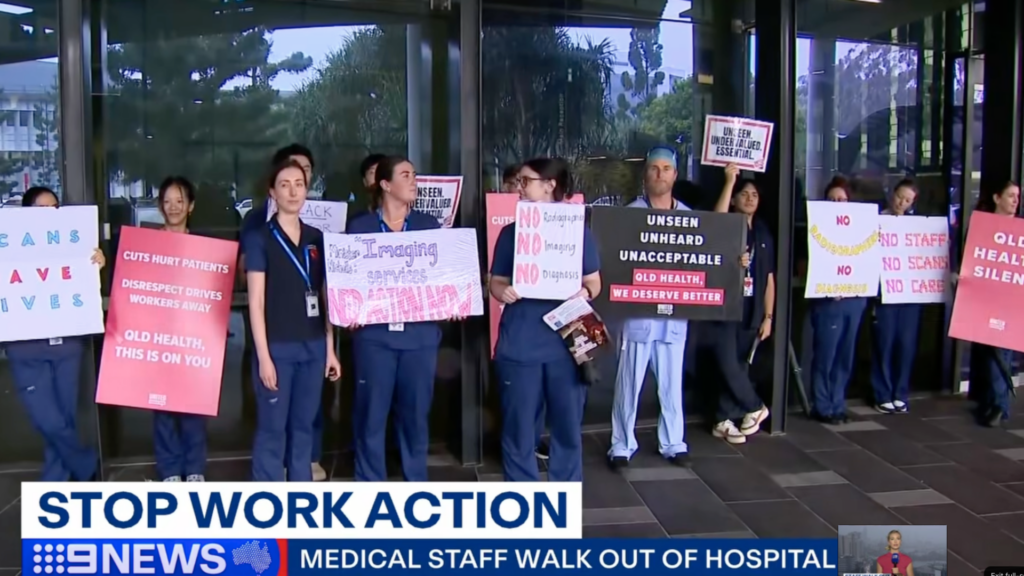
“Queenslanders want their hospitals fully funded and critical health workers to be paid properly.”
Over 200 medical imaging department staff in Queensland walked off the job for 2 hours between 1pm and 3pm –their first strike action since 2008 – over a stalemate with Queensland Health about pay and conditions.
A total of 14 hospitals across the state from Cairns to the Gold Coast, were impacted by reduced medical imaging capacities during the strike.
Radiographers, sonographers, radiology sonographers and medical imaging assistants are highly skilled medical professionals who provide vital diagnostic and medical services.
This historic industrial action taken by medical imaging staff is in response to months of negotiations between UWU members and Queensland Health officials.
Queensland Health refused to accept or negotiate around any UWU’s log of claims for these essential health workers.
UWU members are calling on Queensland Health Minister Tim Nicholls to intervene and honour his word to “pay health workers what they are worth”.
Salary cuts of 25% have cut as much as $30,000 off annual salaries, resulting in 6 resignations of highly-skilled nuclear medicine staff so far.
Show your support by signing the open letter. https://dev.unitedworkers.org.au/qld-public-sector-eba-open-letter/
Investment in paramedics and hospital support staff key to reducing ramping this winter
The WA State Government’s Winter Strategy includes important measures members have been calling for to reduce ramping and pressure across Western Australia’s hospitals, particularly investment in patient flow, workforce and care outside hospital settings.
United Workers Union WA Public Sector Coordinator Lisa Judge said the plan recognised that ramping required coordinated action across the whole health system, not just emergency departments.
“For example, UWU ambulance members’ strong advocacy for funding for Extended Care Paramedics has resulted in one of the smartest investments in this winter package. When a highly trained paramedic can assess and refer someone in their living room, that is a person who does not spend hours deteriorating in an emergency department corridor. It is better for patients and it takes real pressure off hospitals.”
“We have seen this program work. Keeping people safely at home where possible, particularly older Western Australians, is common-sense health policy and it is exactly the kind of reform frontline workers have been calling for.”
“Health workers across the system, including our members alongside doctors, nurses and public sector workers represented by the AMAWA, ANF and HSUWA, have been clear that addressing ramping requires action across patient flow, workforce and care outside hospital.”
Ms Judge said the announced increase in orderly and hospital support staffing was essential to improving patient flow and making additional beds usable.
“Boosting orderly and hospital support staff numbers is just as critical. Support staff are the engine room of a hospital. They clean beds, move patients, deliver equipment and meals, and without them nothing flows,” Ms Judge said.
“Workers have been telling us for years about the waste of having a patient waiting in ED for a bed that is empty but cannot be turned around for two hours because there are not enough cleaners and orderlies on shift. In winter, when support staff get sick like everyone else, those delays blow out quickly. Building real surge capacity is an essential step.”
“On any given day, staff know the system has effectively been short around 300 beds. Adding 200 and combining it with diversion measures is a sensible response to that reality. It responds to what workers experience every shift.”
Ms Judge said the Government’s focus on patient flow, workforce and supporting older people to safely leave hospital reflected priorities health workers and unions had been raising ahead of winter.
“Many of these measures reflect the practical solutions the joint health unions put forward in our five point plan released last year.”
“It is positive to see the Government respond to that detail. The test now will be whether there are enough staff on deck and properly supported to make this plan work where it matters, on the frontline.”
ECEC members calling for big changes to pay and conditions

The Early Education Multi Employer Agreement helped win a 15% pay rise – now it’s time to build on that.
This year, educators will negotiate their pay and conditions through the Multi Employer Agreement. This is a sector-wide agreement currently covering 555 employers and 50,000 educators. It’s massive!
But it’s going to take educators standing together to win the big changes we want.
We’re calling for big and ambitious changes to our pay and working conditions. And we need you to back these claims.
Here’s what we’re are fighting for:
- A fair wage increase – there’s no going back!
- Better ratios for children and educators
- Paid professional development to support our important work
- Tackling wage theft in ECEC
- Backing educators as they face new regulatory requirements, greater scrutiny and higher penalties
- Fair and adequate non-contact time for every educator
- Supporting these claims shows that educators are standing together. The more people who endorse it, the stronger our position at the bargaining table.
If you’re an ECEC member, endorse the claims here https://dev.unitedworkers.org.au/ecec-log-of-claims/
Queensland UWU warehousing members take action for same job, same pay!
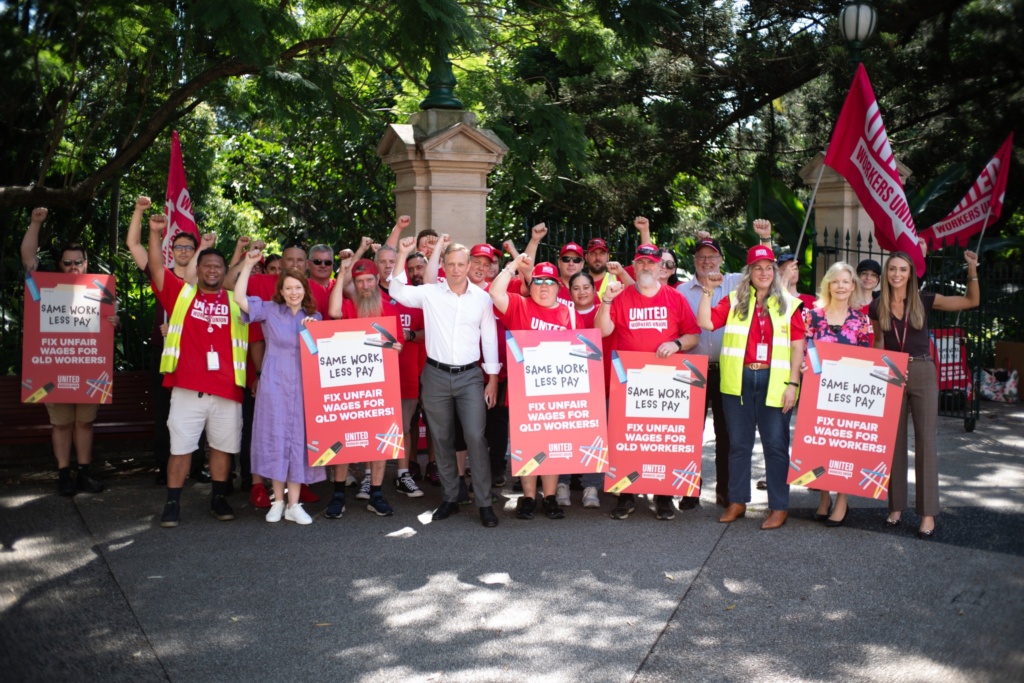
In February, UWU members from Winc Australia in Queensland stood outside Parliament House alongside supportive MPs, calling for pay parity with their interstate colleagues.
These members pack and distribute essential stationery and office products that supply schools, hospitals and government offices across Queensland. But despite doing the exact same work, they are paid up to 15% less than Winc workers in Sydney and Melbourne.
Workers at Winc refuse to accept another wage offer from the company that sees them paid approximately 11% less than Winc workers in Sydney for doing exactly the same job. They chose to rally outside Parliament and call for political support because Winc has the Queensland Government contract to supply stationery and business supplies to the Parliament.
United Workers Union official Penny Vickers said paying Queensland workers less was a hangover from many years ago, but current cost-of-living issues in Queensland have erased state-based differences.
“Living costs used to be cheaper here, the companies could get away with it. But now Brisbane housing costs much more than Melbourne, and is on track to match Sydney in 5 years. Entry level housing is now the most expensive in the country.
“The most recent inflation figures show Brisbane with the highest capital-city inflation at 5.2 per cent a year. Do we get cheaper power bills, cheaper groceries or medical care? How does Winc justify paying workers from Queensland so much less?
“Why do these companies get discount labour in Queensland which hits workers, families and the state economy?”
Winc generated around $708 million in revenue last year and is being marketed for sale as a profitable asset. Meanwhile, Queensland members continue to fall behind, even as Brisbane’s cost of living rises.
Support Queensland Winc workers who are standing together and calling on Winc and Platinum Equity to fix the pay gap and deliver same job, same pay. Sign the petition here: https://dev.unitedworkers.org.au/support-winc-workers/
Schools praise NSW school cleaners
From 1 January 2026, about 900 school cleaners in the Central Coast, Hunter and Newcastle region of NSW transitioned to direct government employment. School cleaning members in NSW fought for years to bring school cleaning back in-house. Government-employed cleaners won an immediate 5% pay increase and better job security, but UWU members are the only ones to benefit from this change.
The beginning of the 2026 school year saw school teachers and staff warmly welcome cleaners into their new jobs, and schools are already noticing the difference. The department has been receiving positive feedback from school staff who are reporting that schools are cleaner.
A staff member at one school said, “Thank you for your hard work within our office. Our cleaner, Sonya, has certainly made a huge improvement in our office. THANK YOU!”
School cleaning delegates and members across NSW aren’t done yet though. They’re continuing to campaign the NSW government to stick to the path of direct employment so that all school cleaners around the state, and all NSW schools, school staff and students can enjoy the benefits.
Check out this video to hear more about the campaign and how members feel about this important win.
Members meet with Sydney Airport CEO
UWU delegates and officials recently met with Sydney Airport’s management, including CEO Scott Charlton. They discussed the Sydney Airport Master Plan and the need for the Airport to ensure good jobs and safe workplaces throughout its operations and supply chain.
Airports are major employment hubs and can play a hugely important role as a contractor in setting standards and eliminating the poor employment practices that members have experienced.
It’s encouraging that Sydney airport management is listening to UWU members. It is to be hoped they have learned from their Canberra neighbours following last year’s poor decision by the Canberra Airport Group to award their security contract to the notoriously anti-union contractor, MSS Security, and the bungled contract transition of Canberra Airport Security Officers that followed.
UWU members should be involved in any decisions that affect our jobs and working conditions. We welcome any further opportunities to consult and advise on the Sydney Airport Master Plan.
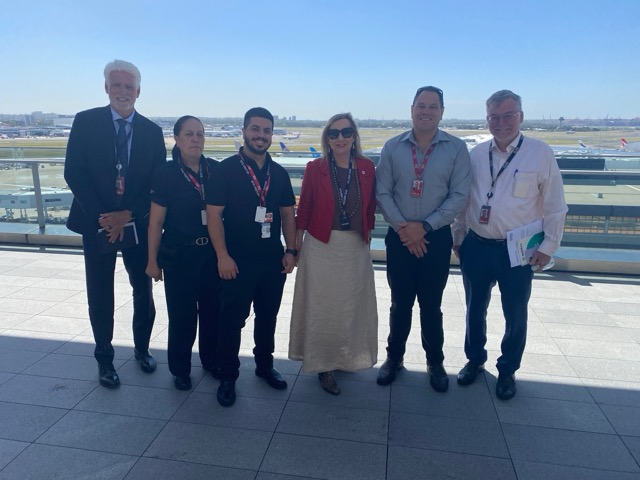
Pictured (L-R): Scott Charlton, CEO SAC; Laina Rapaea, UWU Delegate; O’Neil Benjamin, UWU Delegate; Lyndal Ryan, UWU Vice President, Director Property Services; Carl Ratana, Aviation Lead; Ted Plummer, Senior Adviser Government and Community Relations
UWU advocating for strong government procurement practices
UWU warned government about serious issues with MA Services prior to the company's collapse that saw 1700 workers lose their jobs two days before Christmas.
Reckon you’d have job security, fair pay, good conditions and respect if you worked for the government? You would – on the condition they didn’t use dodgy contractors time and time again in their procurement process. Cleaners and security guards working under contractors hired by the government constantly have their wages and conditions going backwards every time a new contract starts. On top of that, contractors like MA Services Group – which WAS a major security company who provided services for the government and retailers like Coles, Kmart and Aldi collapsed last year and exploited workers … and the public paid for it.
It was reported that MA Services group hired security guards (UWU members) through layers of company dodgy subcontractors, who evaded taxes, and failed to pay worker entitlements including superannuation. UWU repeatedly warned state and federal government about risks in security procurement, and in particular MA Services. Our warnings were ignored and workers were left without a job two days before Christmas 2025 after the company collapsed.
Many workers with MA Services are not permanent residents, so they’re not entitled to access the Commonwealth scheme that protects worker entitlements after a company collapses because of their visa or work status.
This example highlights the long-standing warnings from workers and unions that weak procurement rules allow exploitative contractors to win government contracts over companies doing the right thing (like paying workers a good wage, job security and good conditions).
UWU is advocating for a ‘Commonwealth Secure Australian Jobs Code’ for government procurement to protect workers from bad contractors, bring jobs back in house, protect workers’ pay, conditions, and allowances when they get a new contractor, consult with unions and workers about best practice, and apply higher standards to companies instead of choosing the cheaper option.
UWU has also been liaising with AustralianSuper to help former MA Services members to recover unpaid super.
UWU Election 2026
Soon you’ll have the chance to vote in our union election. Ballots will be posted to all eligible members by the Australian Electoral Commission (AEC). The AEC is an independent authority responsible for maintaining an impartial electoral system.
Eligible members will vote for convention delegates who, once elected, will vote for a leadership team. Much like in a federal election, UWU’s membership is split into electorates based on the number of members who live in each area. The number of convention delegates to be elected from each electorate can be found in the Election Notice from the AEC.
We will provide further information to members about the election process over the coming months.
You can find the Election Notice from the AEC and individual, and team, nomination forms here.
Who gets your super if you pass away?

A message from AustralianSuper
Super generally isn’t covered by your will, so it’s important to nominate a beneficiary so your super fund knows where you want it to go when you’re gone.
To check who you’ve nominated log into your super fund account. You can also call your fund or check your latest annual super statement. If you have multiple super accounts, consider checking each one.
To make or change a nomination, log into your super fund account, look under Beneficiaries and follow the prompts. You can also contact your fund.