

RSPCA workers in SA strike for first time ever

Members and their solidarity pets came out in support of the RSPCA frontline workers in September for strike action to fight for a fair deal.
As the first responders to animal cruelty in South Australia, workers handle more than 4,000 cruelty reports each year – from rescuing abandoned animals to confronting some of the most distressing cases of neglect. The toll on inspectors is real.
Over 85% of staff voted ‘No’ to RSPCA’s shameful deal that attempted to slash inspectors’ pay by nearly 20%, remove on-call allowances worth more than $10,000 a year, and reject basic mental health support.
“This work takes a heavy mental toll. We’re looking out for the animals but who is looking out for us?”
Love for animals doesn’t pay the bills, respect for animals must start with respect for the people who protect them.
A call-out on social media for solidarity saw supporters posting pet pics, check them out or watch this video to hear more about the campaign.
UWU is Advocating for Workers' Futures
Over the last two months, UWU industries and sectors took centre stage in media coverage of the Productivity Commission: 5 Pillars Inquiry into boosting the nation’s productivity.
This media commentator pointed out that conversations around productivity should probably be taken away from economists. We want to hear from the workers at the centre of it all – the carers and educators who make it possible for everybody to go to work.

The government’s acknowledgement that our sectors are central to a productive economy is welcome. But UWU’s response to the inquiry emphasises a focus on improving workers’ experiences. Worker-centred reform is what will improve our economy, rather than financial incentives for employers. We believe the Commission’s 5 Pillars is a missed opportunity to adopt innovative approaches for a more productive economy that focusses on workers.
Key recommendations from UWU are:
- Building a skilled and adaptable workforce: Rather than offering financial incentives to employers, UWU recommends ‘directly improving access to workplace-related training for workers.
- Harnessing digital technologies: UWU recommends creating AI Implementation Agreements between workers and employers with ‘guarantees on job security, skills development and retraining, transparency over all technology used, genuine privacy protections for workers, and protections on the collation and use of worker data.’
- Delivering quality care more efficiently: Overall the inquiry missed the mark on regulatory reform in the care and early education sectors through ‘a lack of knowledge by the Commission of how specific care sectors work’. A one-size-fits-all approach will not work. And due to years of work already completed in the ECEC sector to improve safety and quality of care, many of the government’s proposed reforms are already outdated.
UWU makes regular submissions to government bodies focussing on our industries, so our members can influence reform in favour of workers. You can find some of our most recent submissions that cover wages, surveillance, on our website here.

Tassie education facility attendants stop work

In September about 800 Tasmanian UWU members who work as cleaners, grounds staff and in kitchens in schools across the state walked off the job for a day forcing 14 schools to close for the day. That schools were unable to operate without these workers just goes to show how crucial their work is.
Members have been negotiating with the Tasmanian Rockliff government for several months. They’re calling for the government to urgently increase resource funding in November’s state budget which hasn’t increased for 28 years.
UWU Tasmanian secretary, Amy Brumby said, “schools are very different now than what they were in 1997 when the workload allocation was done.
“Their workload has increased dramatically but their additional hours and their resources have not kept up with that.
“We’re asking for additional resources for our cleaners and kitchen assistants, who are overworked and sometimes actually work for free to get the job done.”
This stop work action led to members setting a meeting with Premier Jeremy Rockliff.
$37k wage theft! Hospo workers in Tas take action
“The feeling of standing shoulder to shoulder is awesome.”
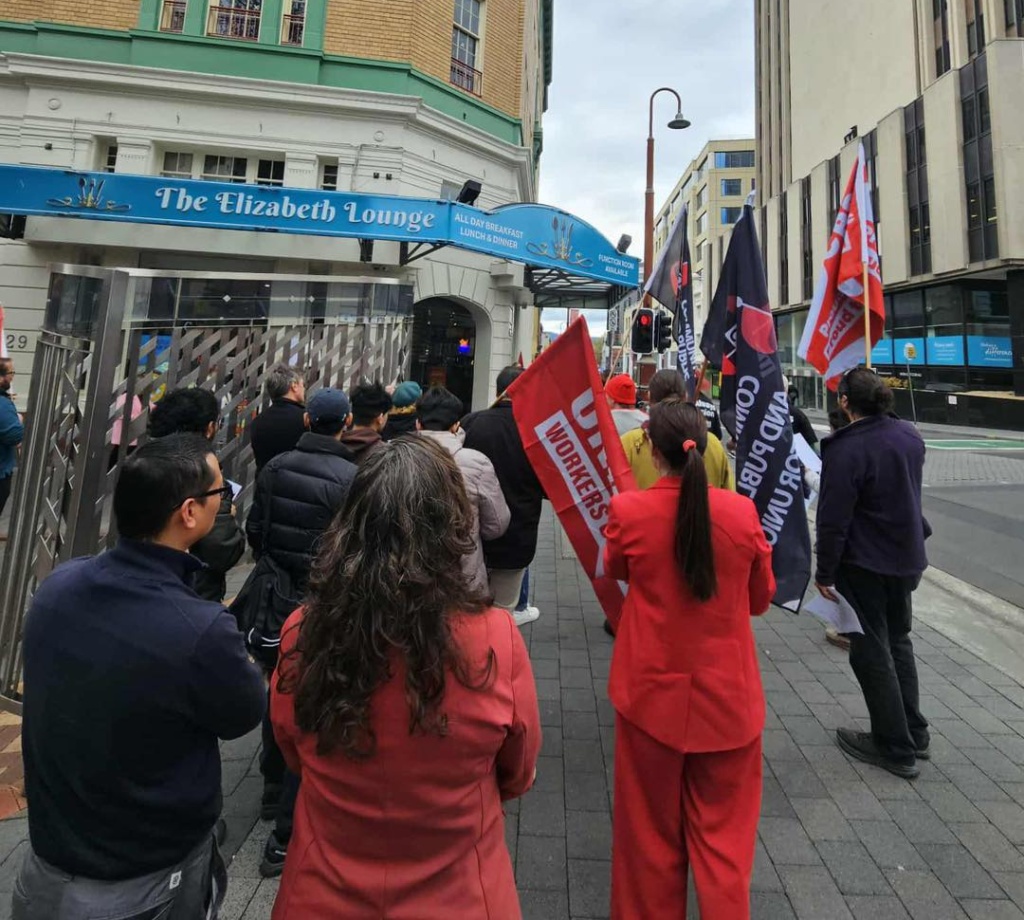
On a busy Friday lunchtime on 26 September, hospo workers in Tasmania had a snap protest in Hobart’s main thoroughfare outside one of the city’s most popular spots.
The owner of Elizabeth Lounge, known as ‘Hobart’s Heritage Café’ advertises being 100% Australian owned, serving Fair Trade coffee, but failed to pay its workers properly to the tune of $37,000. Wage theft is a crime. These workers are demanding justice.
United Workers Union members stood up against their employer after multiple emails and many chances for the owners to do the right thing.
But after hearing nothing in response, a snap protest put a spotlight on employers doing the wrong thing, showing no regard for the workers that have made their business a success. Café customer regulars joined in solidarity saying they’ve ‘changed their lunch break’ in favour of establishments that actually pay their workers fairly and legally. Solidarity with all the hospo workers and UWU members who deserve better.
Rally at Mali's
About 400 workers took action in the Rally at Mali’s – making it the biggest protest of health support and disability support workers since negotiations began in February.
Premier Peter Malinauskas heard United Workers Union members saying with one voice they want a fair pay offer that gives them cost of living relief sooner rather than later.
The protest brought together workers from all major Adelaide hospitals in both metro health networks, Disability Support Officers, aged care workers and early educators.
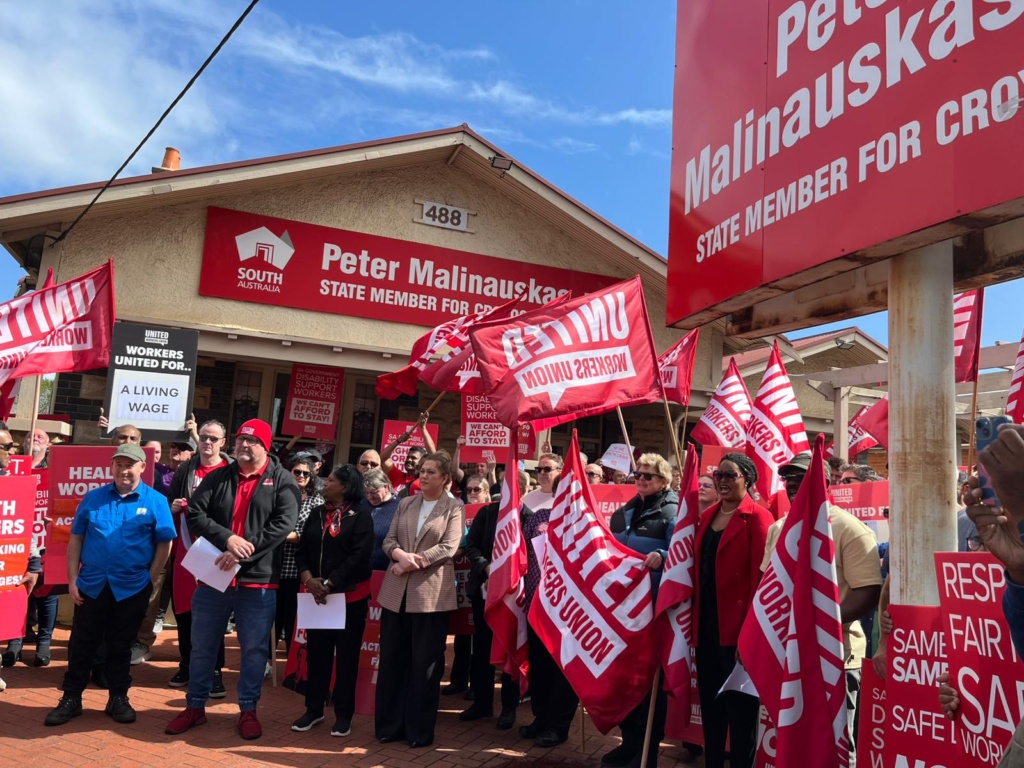
Standing outside the Premier’s electorate office, the workers told the Premier loud and clear that the current offer:
- Fails to address workers’ claims for urgent cost-of-living relief;
- Fails to address the pay gap with workers doing the same job in other states;
- Fails to properly recognise members’ sacrifice for working on a Sunday, and;
- Fails to fix the narrowing gap between pay points.
Workers are committed to further action if their demands are not met. Watch this video to hear from a couple of the speakers at the action.
Five-point plan to tackle ramping in WA
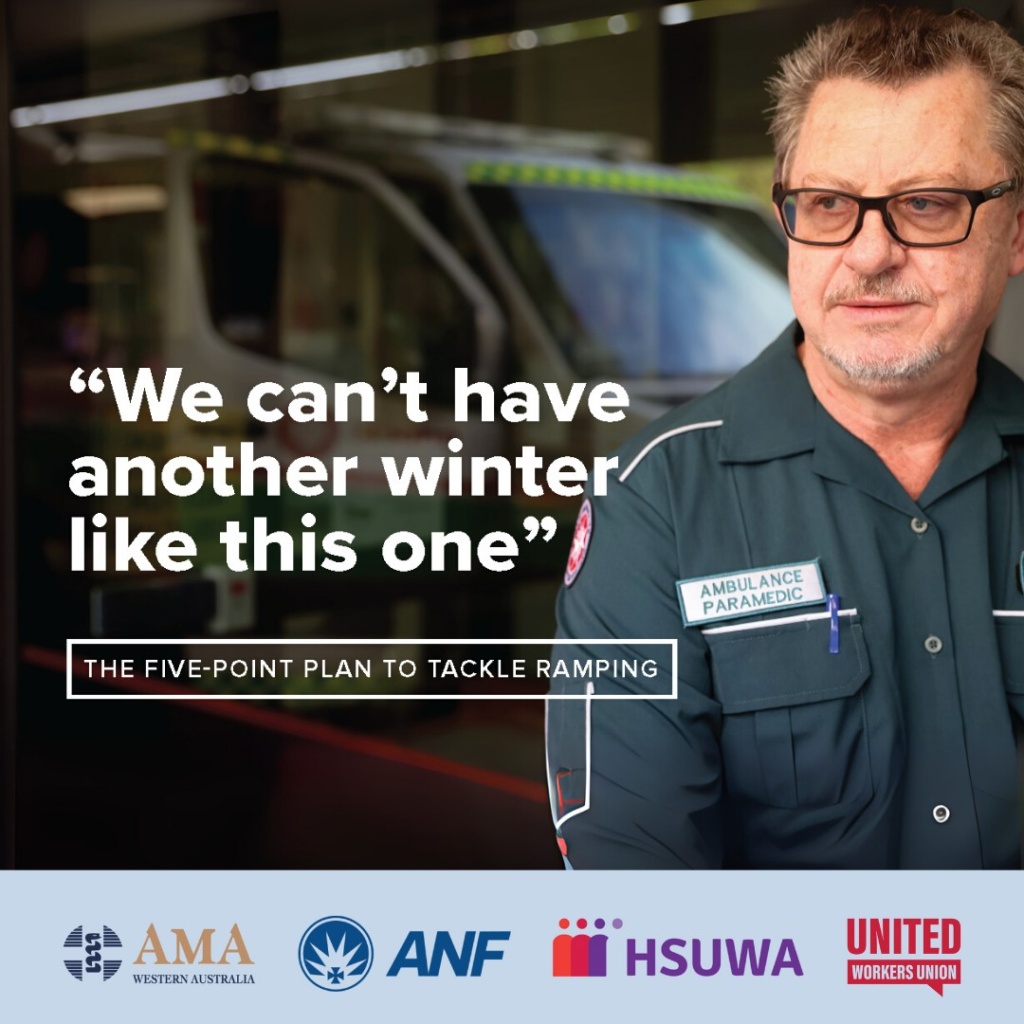
After a year of record peaks in ramping in Western Australia – ambulances queued at hospitals unable to unload their patients at hospitals – an unprecedented alliance of health workers and health unions who cover more than 90,000 health workers in Western Australia have united to say “never again”.
Health workers through their unions – United Workers Union, the Australian Medical Association, the Australian Nursing Federation and the Health Services Union – are putting forward a positive five-point plan to tackle the underlying causes of ramping.
Health workers are united on the fixes needed, and they are putting forward positive, solutions-focused measures.
Doctors, nurses and midwives, allied health professionals, health support staff and ambulance workers carried on under incredible pressure while they met the needs of patients – but they can’t have another winter like this one.
Carolyn Smith, United Workers Union WA State Secretary, said: “Creating more aged care beds will be a massive pressure release on a hospital system that went too close to breaking this year.”
The five-point plan calls for:
1. 400 more aged-care beds
Move non-medical cases into the right care to free acute wards for those who need them most.
2. New Emergency Department diversions for better pathways for care
The best diversion is prevention, therefore it is essential to ensure immunisation remains a high priority in the community. Beyond that, expand public health options including access to primary care, Virtual Emergency Departments, sexual assault and domestic violence services, extended-care paramedics and acute mental health supports to keep people out of crowded emergency rooms.
3. Staff every bed
Safe health care requires enough staff to have every bed open, especially during winter peaks.
4. A 24/7 State needs 7-day hospitals
Operate services at full capacity across weekends to smooth Monday surges and ensure continuity of patient care.
5. One rulebook for a unified approach to health care
Set clear, system-wide protocols so patients get timely, consistent treatment everywhere.
Read more about it here.
WA Park Rangers take action
“We’re not asking for luxuries, but for fairness: fair pay to cover our bills, and safe working conditions so we can go home when we finish work.”
Park rangers are the backbone of our national parks all over Australia, and in West Australia they take care of over 100 national parks dotted around the state. They care for wildlife, find you if you get lost bushwalking, protect your safety, fight fires to prevent damage to country, clean and maintain the public picnic and camping areas. It’s physically demanding work often in extreme weather conditions. They work weekends, public holidays and are on-call 24/7 in case of emergencies.
But their employer, the WA Department of Biodiversity, Conservation and Attractions and Environment Minister refuse to give them a fair deal. The hours that rangers work – public holidays, late nights, early mornings – mean they miss out on their family life.
“This job has meant we’ve missed too many of our kid’s weekend sports events and performances, weddings and birthdays of friends and family, and been isolated and alone, all while struggling to manage our bills.“
Understaffing means little time off and entry level rangers earn not much above minimum wage.
“Rangers in remote areas are worked 20 and sometimes 30 days straight without a break to cover for shortages.“
That’s why rangers took action after negotiating for over 18 months to get the government to listen and respond to their demands.
What action did they take? Rangers are still keeping your parks safe, but they’re not collecting fees until they win the respect and compensation they deserve.
How does your pay compare? Check pay rates across Australia with EarlyEd Quality Check.
Members are keeping Early Education providers accountable and making sure all educators are getting the pay they deserve, using a new report on our EarlyEd Quality Check platform.
Built by educators, for educators, EarlyEd Quality Check lets educators report on safety and staffing, share their own stories, and now report and compare pay rates across Australia with a new Pay Report feature.
More than 250 educators have already anonymously shared their pay, building transparency in the sector and showing authorities the importance of fair pay. In some regions, educators are reporting differences of more than $5 per hour for the same role.
Fair pay is essential for a safe, high-quality early education experience for children. Our members keep telling us: you can’t achieve this if you have exhausted, overworked educators who can’t afford to stay in the sector. Help us keep building national pressure to fight for fair pay for educators. Head to EarlyEd Quality Check now and share a pay report!