
THIS UWU MEMBER WON A $10k SALARY INCREASE
Sometimes it just takes a phone call to start the ball rolling on a massive pay rise.
An employee (and UWU member!) at Roy Morgan Research won a substantial pay rise with the help of UWU’s Member Rights Team (MRT) member Bertie Meyer. How did they manage it?
This member had been employed at Roy Morgan Research in Melbourne for about 4 years when he contacted MRT. He was classified as an Operator, but firmly believed he was performing the duties of a manager role without being recognised for it.
After putting in a detailed request for reclassification with his annual performance review in August last year, he never received an outcome despite multiple follow-up attempts.
The enterprise agreement that covered his employment had expired in 2017 and didn’t include a clear pathway for promotion. To be paid at a higher level in the (now expired) agreement, he would be required to supervise other staff. But, because he was the only person in the department, there wasn’t anybody else to supervise. So…
UWU’s MRT escalated the issue of his reclassification with HR, who promised to follow it up. But then, the employer agreement was terminated and our member was told he was now covered by an Award at Level 7, resulting in no pay increase or title change! This was less than acceptable.
Another meeting was requested with HR to try and finally resolve the issue. HR agreed to recommend a salary increase and title change to the company’s CEO. The CEO agreed. The member went up a level in the Award and was given a $10,000 increase in his annual salary.
No matter what your role is, if you’re performing higher duties than your pay level, give the UWU MRT a call. Contact details for your state or territory can be found here.
how members can fight back against overuse of ai
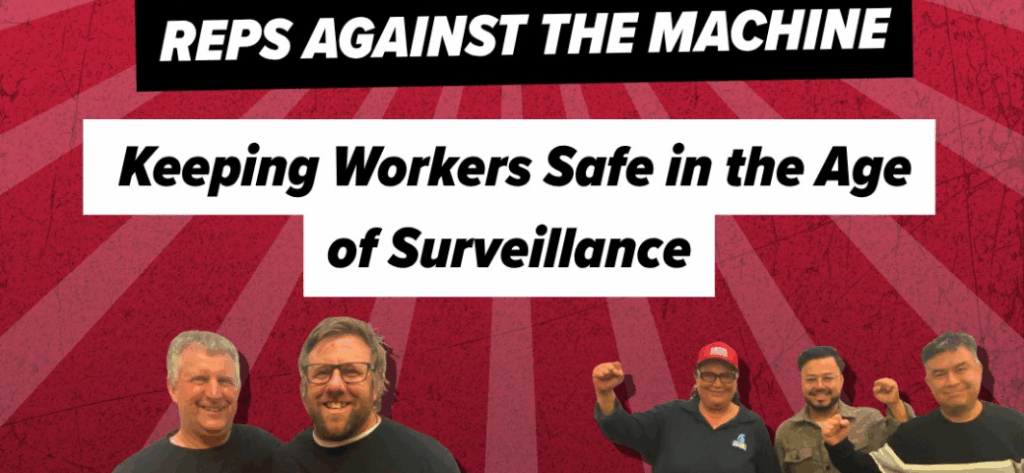
Health and Safety Reps (HSRs) across Victoria got together for the 2025 HSR Convention, ‘Reps Against the Machine’ to learn from each other, confront the increasing use of Artificial Intelligence (AI) in workplaces, and address the health and safety issues created by its use.
Many workers don’t even know that AI is being used in our workplaces. Surveillance, monitoring, work intensification and digital systems are changing our workplaces and already creating physical and psychosocial hazards.
UWU HSRs from Woolworths spoke about how their site introduced AI digital surveillance systems that monitored their productivity in real time. This system enforced unfair pick rates that led to workers risking their health and safety to keep up with impossible standards. Fatigue wasn’t considered as a risk by management, workers were not consulted, and the new pick rates were used to discipline workers if they weren’t performing to unreasonable standards. On top of this, surveillance increased and workers were constantly being monitored, creating psychosocial and physical hazards for workers. But HSRs stepped in and spoke up. Last year, these workers even went on strike against the oppressive use of AI. They won proper consultation, control over pick rates and stronger safety protections in their agreement.
AI is increasingly being used in our workplaces, but workers need to have a say in when, if and how it gets used. AI use can become both a physical and psychosocial hazard through being constantly monitored and tracked, intensifying our workloads by setting unrealistic standards and creating uncertainty around job security.
Every worker has the right to a safe workplace, free of both physical and psychosocial hazards. Our workplaces are safer when we have HSRs, It’s that simple. Want to know more? Check out Woolies HSR’s speaking at the convention on our socials and talk to your HSR about AI and technology at work, or if don’t have an HSR at your workplace, talk to your organiser about becoming one!
Embedding CULTURAL LEAVE in workplace agreements
It’s time our enterprise agreements recognised the many cultures that make up our country.
ACTU held the Aboriginal and Torres Strait Islander Conference in October in Victoria. The conference provides a space for listening, learning and leading. This year’s theme was Anti-Racism, Truth & Treaty. Discussion covered building strength in shared stories, growing skills, and taking action together.
There was broad recognition and understanding that workplaces today bring together people from many cultures and that diversity makes us stronger. But the rules that shape work weren’t built with everyone in mind. It’s time our enterprise agreements recognised the many cultures that make up our country, including the world’s oldest continuing cultures of First Nations peoples.
The UWU First Nations Roundtable is leading a push to ensure cultural leave is part of enterprise bargaining, so that First Nations members can take part in ceremony, sorry business and community life without losing work or wages.
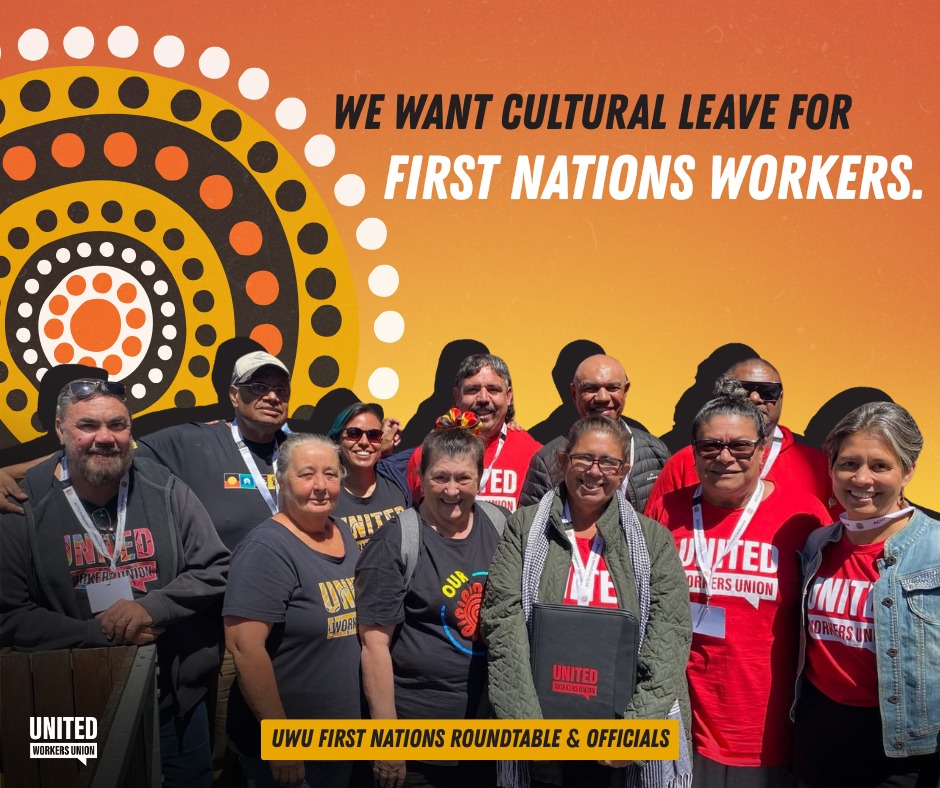
Their presentation explained to other attendees from unions across the country how UWU members are embedding cultural leave in union agreements, showing what genuine First Nations leadership looks like in our movement.
The Roundtable leadership has set the benchmark for First Nations engagement across the union movement and the growing number of UWU First Nations members is proof of that strength.
By recognising all cultures, we build stronger workplaces where every member stands united and respected.

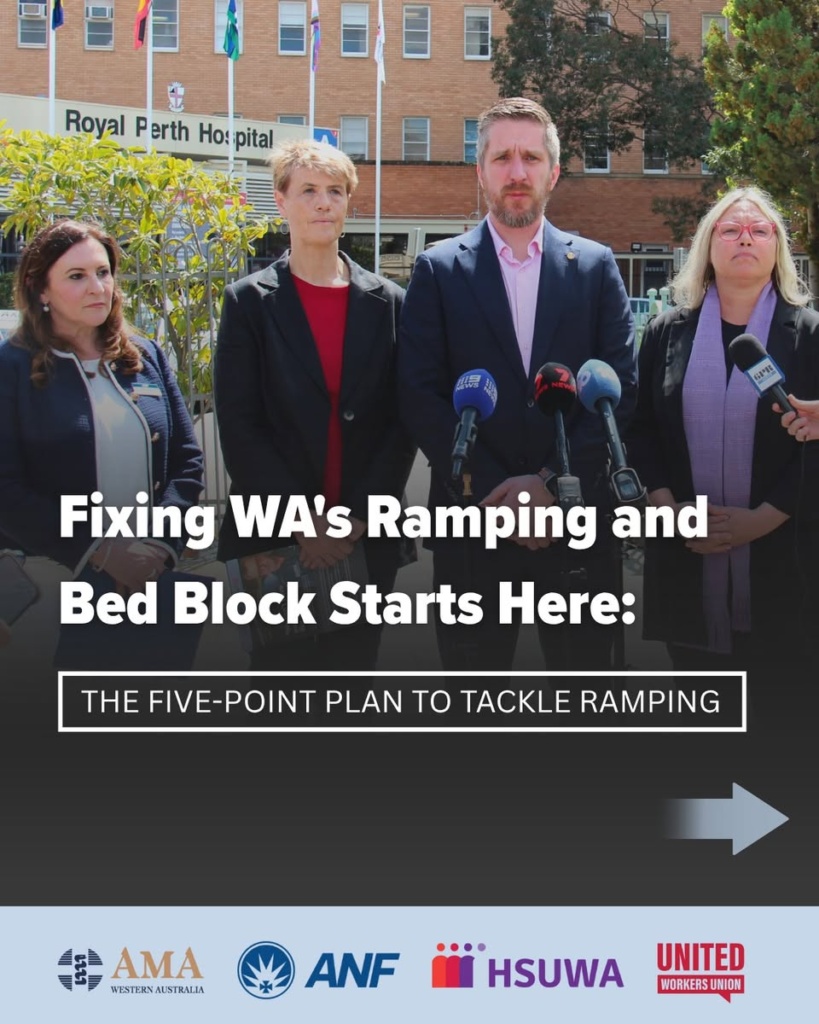
5 point plan to fix wa ramping crisis
We’re working together to make sure patients get the care they need.
UWU has joined with the Australian Medical Assoc (AMA), the Nursing Federation (ANF), and Health Services Union (HSUWA) to call for change to fix the ongoing issues facing our members in WA.
The health workers of WA are united and we’re putting forward real solutions with a five-point plan to tackle ramping and bed block:
1. 400 more aged-care beds to free up hospitals
Hospital beds are being filled by patients whose needs could have been met elsewhere. Adding 400 properly staffed aged care beds would free up acute wards for those who need them most, easing pressure on hospitals across WA.
2. New pathways to keep people out of crowded EDs
We’re calling for an expansion of public health options such as primary care, virtual emergency depts, sexual assault and DV services, extended-care paramedics, and acute mental health support . By expanding these services, we can reduce the pressure on crowded emergency rooms and respond appropriately to critical medical issues.
3. Staff every bed to guarantee safe care
Every hospital bed must be open anbd fully staffed, including coverage for leave and personal days. Too manyy beds remain closed because there aren’t enough staff to operate them. Safe health care depends on real capacity.
4. 7-day hospitals for a 24/7 state
WA is open 7 days a week, so our hospitals must be too. There must be funding to staff weekends fully, with pharmacy, radiology, pathology and all the other services patients need. Without it, people are left waiting, hospital beds are kept occupied for days and stretch resources across the hospital, displacing resources that are needed to address emergencies.
5. One clear rulebook for consistent treatment everywhere
Right now, patients face delays and inconsistencies because decisions are made differently from one hospital to the next. A unified health system with one clear rulebook ensures patients receive timely, consistent care no matter where they go. For workers, consistency cuts duplication, reduces bureaucracy and lets them focus on what matters most – patient care. One rulebook means safer faster treatment and a workforce empowered to act with confidence.
We’re ready to work constructively with the Cook Labor Government to make this plan a reality and make sure WA patients get the care they deserve.
NEW measure of care time lifts aged care standards
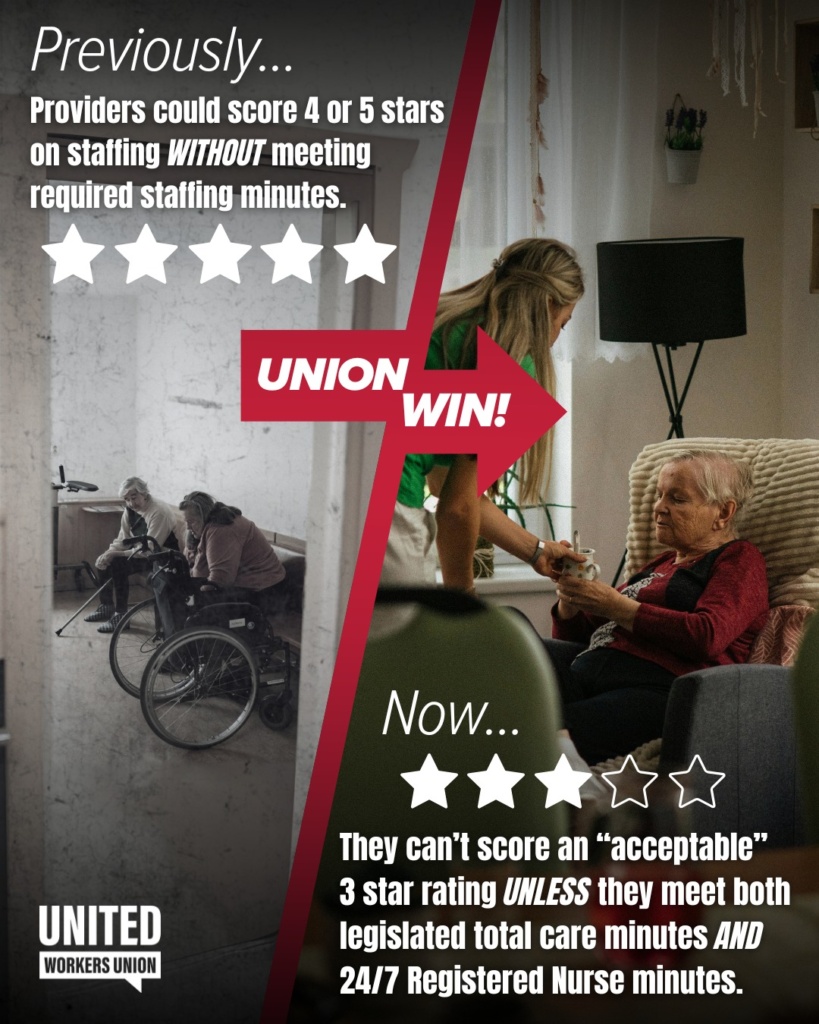
Aged care providers have been getting top ratings while workers were run off their feet. Not anymore!
Did you know that until October 1 this year, aged care homes could score 4 or even 5 stars for their staffing levels in the government’s rating system without even meeting their minimum care minutes?
That’s right! aged care providers were getting top ratings while workers were run off their feet and residents were missing out on the level of care they were entitled to.
Now, thanks to our aged care members standing together, that loophole is closed.
Aged care homes can no longer receive an ‘acceptable’ 3-star rating unless they meet both their legislated total care minutes and 24/7 Registered Nurse minutes.
This change means the system finally reflects reality… and it’s proof that when aged care workers speak up and take action, they make change that protects residents and lifts standards across the sector.
graincorp workers strike over underhanded tactics

GrainCorp workers have had enough.
Around 100 workers across two GrainCorp sites in Geelong and Portland walked off the job over the company’s refusal to implement a workable rostering system, include the provision of safety equipment in the agreement and delivery of a fair pay rise, that helps to close the gap between GrainCorp sites.
The breakdown in negotiations comes after GrainCorp conceded earlier this year it had underpaid Geelong GrainCorp workers to the tune of tens of thousands of dollars by failing to pay workers at the Geelong port a higher duties penalty entitlement for up to 6 years.
Not only have the workers at Geelong GrainCorp been underpaid, the company has also refused to:
- implement a workable rostering system
- include the provision of safety equipment in the agreement
- deliver a fair pay rise, that helps to close the gap between GrainCorp sites.
The 24-hour strike united workers across the two site to send a clear message: we won’t back down when companies play underhanded games with workers’ rights.
If you want to support them and countless other workers across Australia to stand up to their employer, get involved and tell your co-workers to join UWU today!
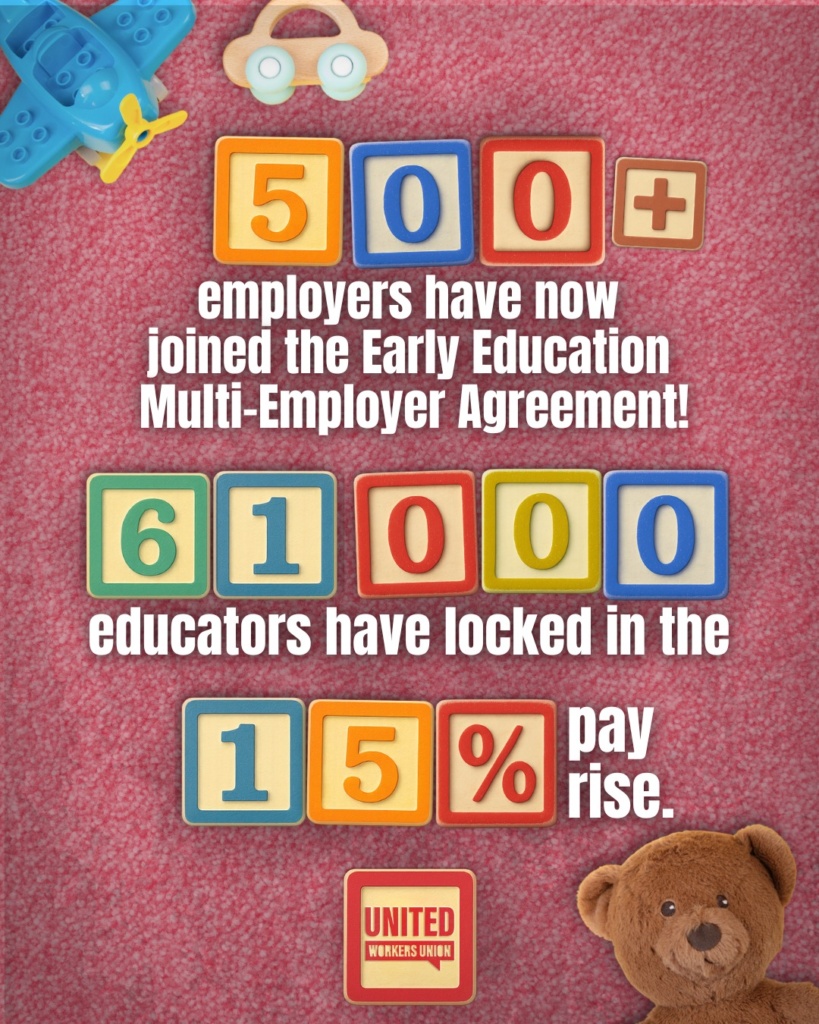
500 employers join ecec multi employer agreement
Huge news for our early education members.
More than 500 employers have now joined the Multi-Employer Agreement, meaning more than 61,000 educators have now locked in our historic, union-won 15% government-funded pay rise!
This is one of the biggest wins our sector has ever seen. And it’s happening because educators stood together and refused to accept low pay and low respect.
If you’re an early educator and you’re not yet part of this movement, now’s the time to get involved. Together, we’re making history, and we’re not stopping here.
could we see an end to under-the-roof ratios?
We told authorities: close the staffing loophole putting children at risk!
Educators have taken their fight to end under-the-roof ratios to the top, presenting more than 1200 messages of concern to the sector’s national regulator.
United Workers Union Officials and members met with Early Education Minister Jess Wash and the Australian Children’s Education and Care Quality Authority (ACECQA) in October to warn them about the dangers of under-the-roof ratios.
ACECQA are currently completing a rapid review of supervision practices in early education, and we’re making sure they know under-the-roof ratios have got to go.
More than 1900 people so far have taken action to tell ACECQA the impact of ratio loopholes and low staffing, signing our digital postcard to voice their concerns.
At the meeting, members shared powerful stories of what under-the-roof ratios really mean: children are left unsafe, unsupported and unsupervised while educators are overworked and burned out. A member and educator from New South Wales shared this story.
“As an early childhood leader, I see every day how under-the-roof ratios fail children and educators. On paper, they meet regulations, but in reality, they leave rooms understaffed, disrupt relationships, and increase stress. Children miss out on consistent care, and educators burn out trying to cover gaps. Ending under-the-roof ratios would ensure fairness, stability, and quality education for every child.”
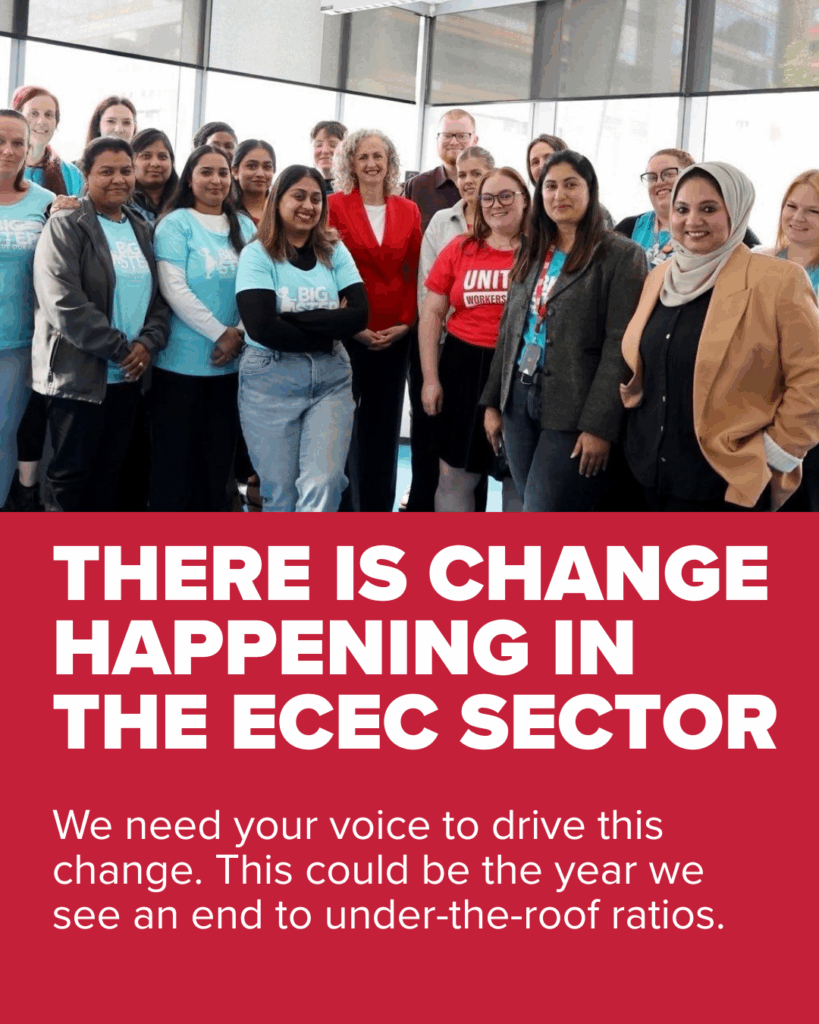
So now it’s time to keep momentum going. There is change happening in the sector, and we need your voice to drive this change. This could be the year we see an end to under-the-roof ratios. With ACECQA due to report back on ratios and supervision in December, every action counts! You can help by:
- Sending a digital postcard to ACECQA, calling for an end to under-the-roof ratios. We’ll keep submitting them on your behalf.
- Visit EarlyEd Quality Check, and make a report about how your centre is doing
- Encouraging your friends and co-workers to join the United Workers Union and support us in raising the standard across the sector.
new agreement a win for safer workplace
Workers at Star Brisbane have finalised their next Enterprise Agreement.
As part of this win, Star Brisbane members have secured improved consultative committee clauses that can ensure workers at Star have their rights at work safeguarded, and issues are handled as they arrive. Want to know more? Reach out to your Casino organiser for details.
Casino Union Paid Time Meetings are happening next month for Star Brisbane, Star Sydney, and Crown Perth employees. Make sure you’re rostered to attend.
Want more details? Contact your site delegate or organiser.

customers come out IN support OF padre strike
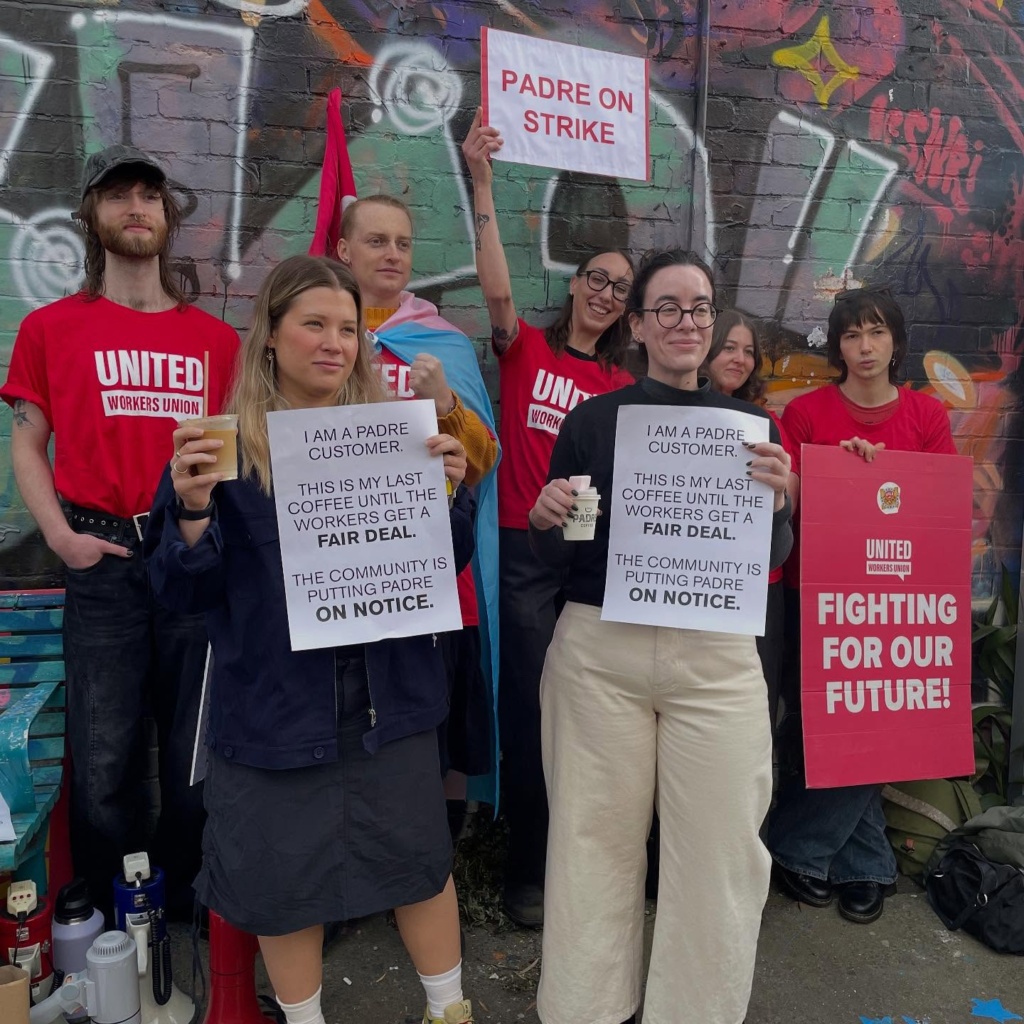
Padre Coffee tells workers they won’t be paid while taking lawful industrial action. This is effectively a lockout!
UWU members work hard producing Padre Coffee for a coffee-focussed and highly unionised community in Brunswick, Melbourne.
Members are in the middle of bargaining in good faith for a new workplace agreement. But Padre Coffee has rejected UWU members’ most important claims around leave and even rejected a wage increase.
In response, members voted to take lawful industrial action — by quietly wearing union t-shirts at work and sharing information with customers about their bargaining campaign.
Padre Coffee has now told workers that if they take part in this lawful action, their work will not be accepted and they will not be paid for any time worked.UWU members are staying strong and won’t let Padre Coffee push them around. If you want to show your support for your fellow members standing up for wage justice, safety and inclusion, join more than a thousand others who’ve signed a petition in support of workers at Padre Roastery.
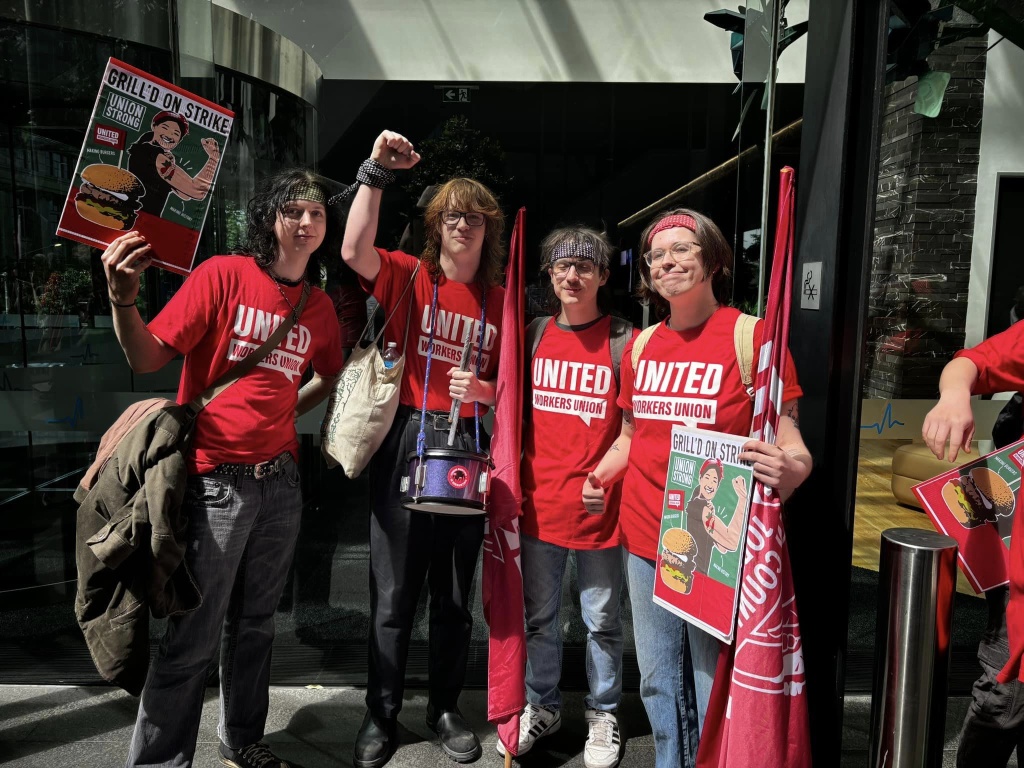
grill'd forced to deliver 6 months backpay
Grill’d workers are proving that when workers stand up and take action together, change is possible.
After years of low pay and dodgy traineeships that kept wages well below industry standards, Grill’d workers organised through the United Workers Union to demand better. Their collective action, including leading the first-ever protected fast food strike in Australia, put national pressure on Grill’d to lift its game.
Now, Grill’d has been forced to deliver an improved agreement. The new deal includes higher pay, six months of backpay, and better working conditions — a significant step forward from the company’s original proposal that would have left many workers worse off.
This progress didn’t happen because the company decided to be fair. It happened because UWU members took action, stood together, and refused to back down.
GRL workers put foot down for job security
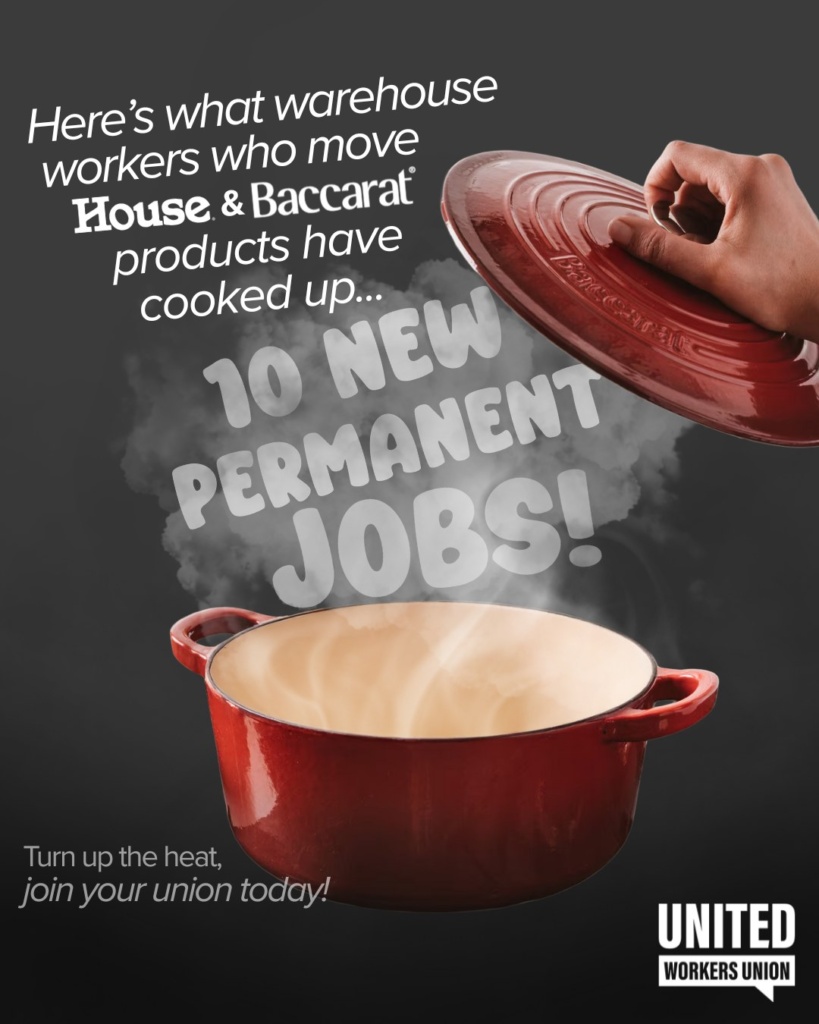
How does a steady, permanent job sound? Better than casual shifts that keep getting dished out unevenly?
Recently at GRL in Truganina, Victoria, the warehouse workers who pick and pack House and Baccarat products turned up the heat and won 10 permanent jobs after enforcing their EBA rights!
It’s one thing to campaign and be involved in bargaining every few years, but it doesn’t stop there. Just because it’s in your agreement, doesn’t mean your employer will offer you permanency. Casual workers who have had regular, consistent shifts over 6 months (or 12 months for small businesses) can request a permanent part-time or full-time position. Your employer must respond within 21 days. Check your award or agreement to find out more and if your employer isn’t coming to the table, contact the Member Rights Team in your state to find out what you can do.
And, if you want to know more about casual workers’ rights, register for our December Member Workshop on the topic. Hear about how to go about getting permanency if that’s what you want, and how other members have done just that.
It’s what happens when you’re union. You stop getting served scraps and start getting a fair deal.
'Spat at and abused': security staff say respect the risk
A security guard at Park Towers in Melbourne says sometimes even the police are scared to come.
Victorian hospital security guards joined with housing guards to stop work and march to government ministers’ offices in Melbourne, demanding respect for the risks they face every day as part of their work.
One member who has been working at a public hospital for about 9 years says he has watched the community slowly change, with violence levels tripling over that time.
“We’ve been spat at, stabbed, abused,” said a housing security guard.
According to UWU members, the measures taken recently have not been enough to combat the risks involved. Anti-stabbing vests are not enough, the issues go beyond that. Members don’t feel they are adequately compensated for the risks they take in their day-to-day jobs.
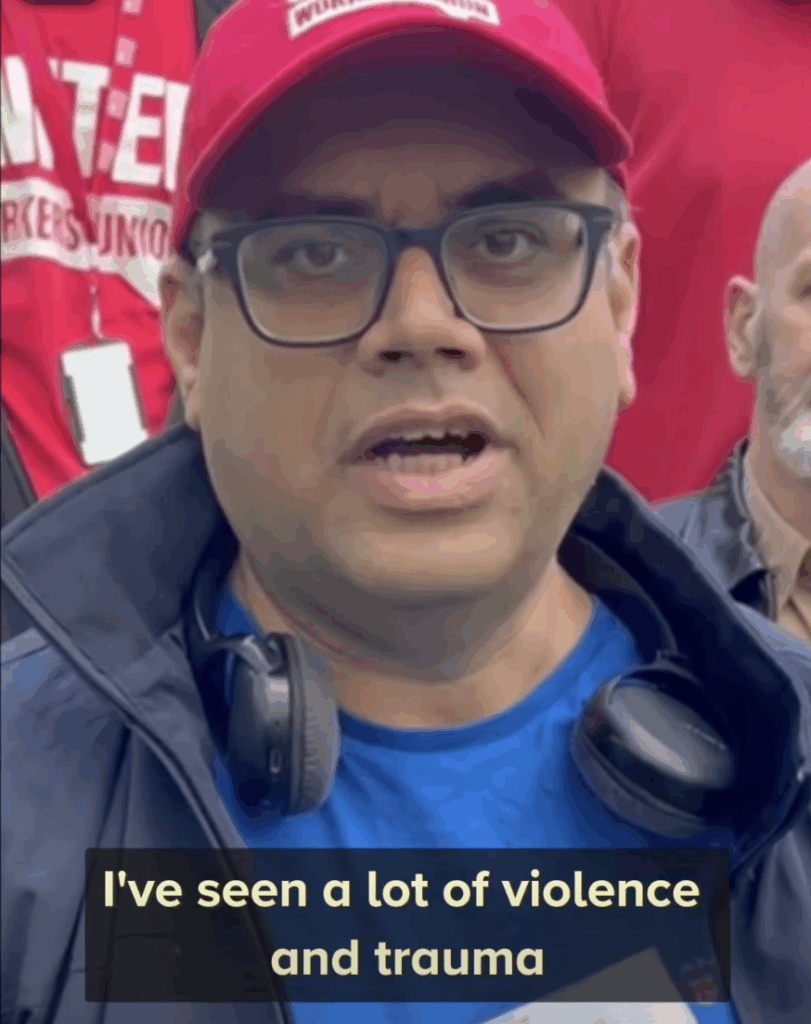
The violence has made it harder to attract guards in the hospital system, which puts further strain on staffing levels making it hard to do the important job of keeping nurses, doctors and members of the public safe.
“We are here to support the hospital guards because their wages have also been stagnant”
These guards are paid hundreds less than directly employed colleagues and are left to face violence on the job without enough consultation on safety. It’s time for the Victorian government to intervene to fix this mess.
Workers are standing together to say, respect the risk, pay the rate!
Why does compounding matter?
If you’re eligible, when you’re working your employer needs to contribute a minimum of 12% (from 1 July 2025) of your pre-tax income to your super account to help fund retirement. This is known as the Superannuation Guarantee. Some employers can pay more than this amount.
Your super fund invests that money into things like shares, property and other assets. Their goal is to help grow your savings over time, so there’s more money for retirement.
What is compounding?
Compounding is when money earns interest, and then that interest earns more interest. Over time, this can help savings grow faster. Think of it like a snowball rolling down a hill. It starts small but grows bigger over time.

How compounding works in super
In a super account, compounding happens when the investments make money, and that money gets reinvested. This can help the balance grow faster over time. Super balances can grow in different ways:
- money from your employer (SG)
- investment returns
- compounding
- voluntary contributions.
Why super is a long-term investment
Super is meant to be saved for retirement. Even though markets go up and down, keeping money invested long term can help to smooth out the bumps throughout a working life. The longer it stays invested, the more compounding can help retirement savings grow.