
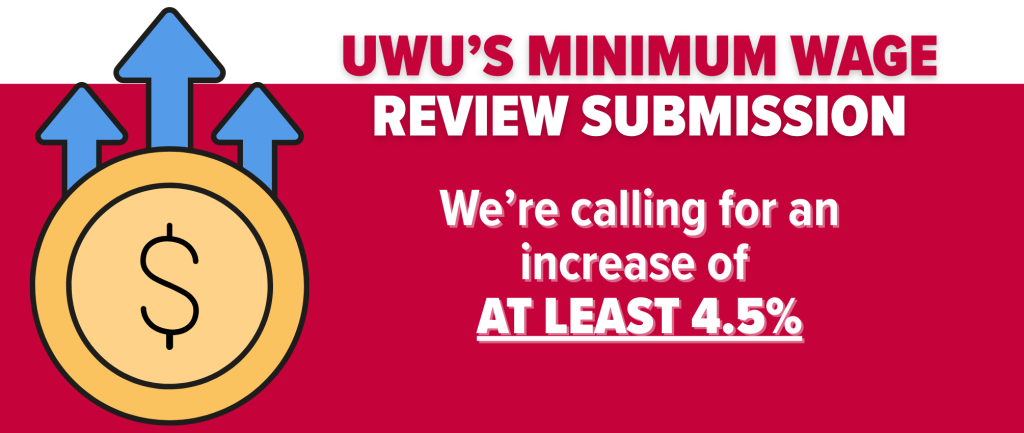
Every year an expert panel at the Fair Work Commission reviews the minimum wage and based on submissions from trade unions, employer groups and various other organisations, decides whether to increase the rate, and by how much. This process is underway right now.
The United Workers Union submission considers, among other things, current cost-of-living pressures, wage growth compared to inflation and asks the panel to understand the real-world impacts that their decision will have on UWU members.
While the review primarily affects the minimum wage and Award wages, it has broader implications for all workers. An increase to the minimum wage helps workers get higher increases through bargaining or if negotiating your own contract.
Union members’ personal experiences are featured throughout the submission, here’s what they had to say.
“It is really difficult to live off this kind of income, I don’t have any money to spend on myself… I’m a single parent with 3 girls living at home and they’re missing out on a lot because things are so expensive… I have housing costs, groceries, petrol and bills…I have to put aside $200 per fortnight just to pay for gas and electricity and even then, I’m still catching up on things so that they’re not overdue… My pantry and my fridge look bare all the time… we can’t get fresh food very often because it’s cheaper for me to buy tinned foods but it’s not the same quality… We’re going to have to start eating less quality food because its more affordable… An award increase could potentially cover some of my petrol costs, so I could put more money towards food or other activities.” – Lorraine, aged care worker
———-
“I look after my husband, who is not well and I have two teenagers at home. I work alternate weekends from 7am-3pm because of the higher penalty rates, it’s a big help getting the double rates because I have a mortgage to pay. However, for me the biggest cost is groceries, which are so expensive, it is sometimes more than $200 per week… Yes, they increased aged care award wages which was great, actually it was a relief and has made things more comfortable but keeping up with the cost of living is still tricky because everything is so pricey…I still have to limit my spending… I have had to cut back on visiting friends, I can’t spend money on clothes and cannot go on vacation or out to dinner which we used to do occasionally…An increase in the award wage could mean that we are able to eat out as a family to treat my kids.” – Josie, aged care worker
———-
“By the time I get paid and all my bills come out I have $200 left for groceries and petrol and it’s crazy. Plus my rent is about to go up … I went to the supermarket last week for standard shop and it was $95; it’s getting beyond a joke…we can’t really do anything anymore: my husband and I, we used to go out for meals occasionally or go for a drive, but the price of petrol and food costs a fortune, so we just can’t do it anymore… An increase would make heaps of difference … we could maybe save for a holiday, a big holiday to maybe see family up in Sydney…. Or I’d like to buy a house someday, but I know I can’t because I’m casual, and I can’t get a home loan or save up for a deposit.” – Sarah, cleaner
———-
“The wages barely keep up with the cost of living: living expenses have skyrocketed in recent times, particularly energy bills… We just had to pay over $200 for an energy bill …our wage is just not enough: a lot of my colleagues say the same thing too. … I can’t afford to treat myself anymore, I used to buy a meal out every so often, but I can’t do that now…I was looking to save up for a car, to make the journey to work quicker and easier, but doing that is very difficult due to the size of the bills that keep coming in … it’s a slap in the face when you see those bills…Minimum award wages are impossible for people trying to keep up with the cost of living.” – Martin, food process worker
———-
“I work Saturday and Sunday to get the penalty rates, because I need the money, so I don’t have a weekend. That was very hard when my kids were little …plus I had to work two jobs to pay for their school fees… but now I’m still paying off my mortgage …I’d like to pay off my mortgage before I get to 65 or 70, that is my dream…If our wage went up I could possibly buy more groceries, because shopping is getting very expensive.” – Gill, cleaner
The FWC decision is usually announced in mid to late June, we’ll keep you posted!
UWU members taking action for fair pay
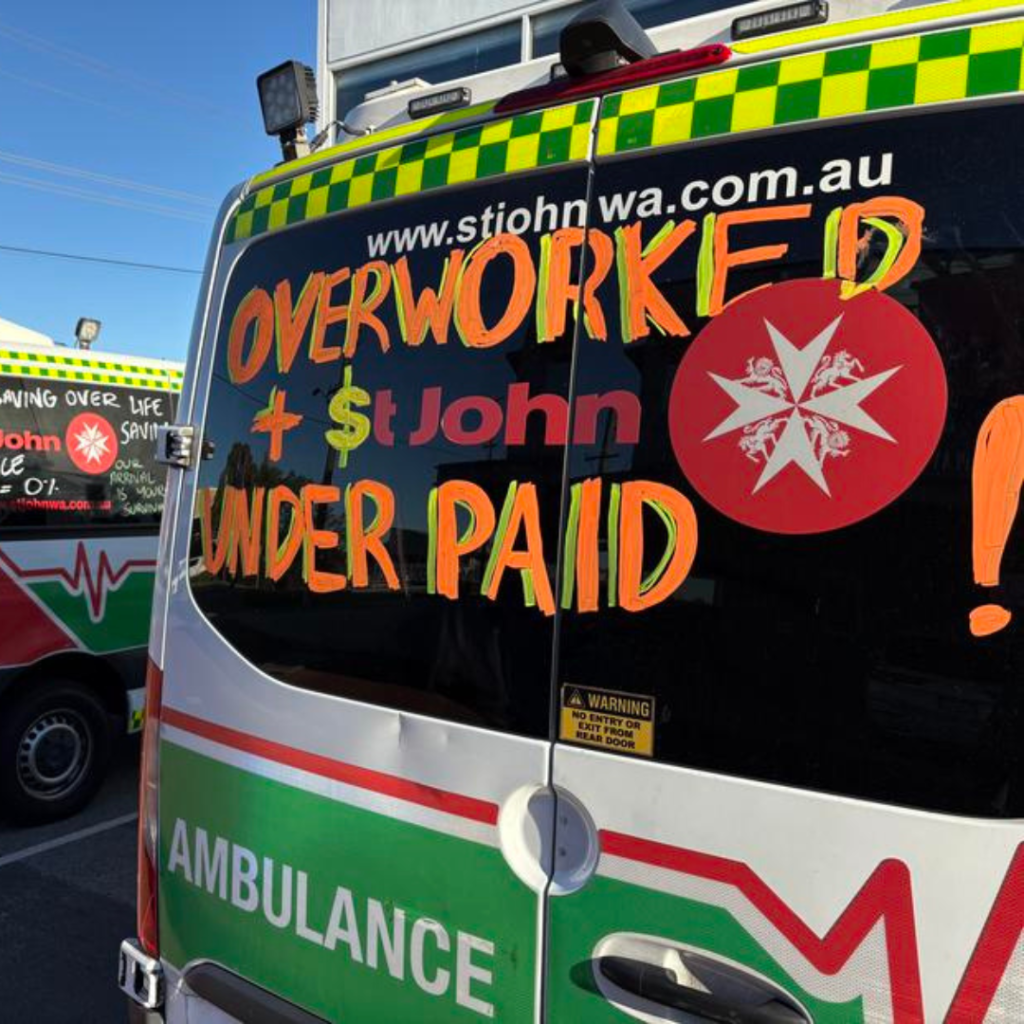
Overworked and undervalued, it’s a common issue we’re fighting to fix in all sectors we represent. In Western Australia, ambulance service management has pushed their workers to breaking point.
In mid April a significant majority of United Workers Union paramedic members voted in favour of protected industrial action to send a message to St John that paramedics and the people of WA deserve a better deal.
Members gave St John Ambulance an opportunity to to avoid industrial action by paying front-line workers what they deserve, but they failed to propose an acceptable offer.
The United Workers Union urges St John to back WA’s state-wide emergency health service by offering its front-line workers a pay increase that assists with the cost of living and reflects the value of the work paramedics perform to save lives.
Experiencing financial hardship?
Whether your pay and conditions are set by an Award, agreement or contract, your union is always fighting for wage increases and better conditions. Despite this, the ongoing cost-of-living crisis is making life hard for lots of members right now.
Last month we were joined by a financial counsellor from the National Debt Helpline to hear advice about how to deal with financial hardship, some tips to help manage our finances and the help that’s available. Here are the top tips that were shared in the workshop.
Help is available
If you’re struggling to repay debts, pay bills on time and/or afford everyday essentials, reach out for help. The longer you wait, the more stressed you’ll be and the harder your finances are to manage.
The National Debt Helpline (NDH) is a free service staffed by financial counsellors. Financial counsellors are different from financial planners and advisors. They assist anyone struggling to repay debts from:
- mortgage
- car and personal loans
- credit cards
- utility bills – electricity, gas, water, telco
- Centrelink
- buy now, pay later
- payday loans/wage advance products
They DO NOT work for banks, private companies or government– they work in community-based organisations and some local government agencies.
How can a NDH financial counsellor help?
- Assess your financial situation – income, expenses
- Look at available assistance, eg. concessions, grants
- Inform on your rights under legislation, industry codes and your contract
- Talk about your options, including prioritising debts, payment arrangements, waivers and bankruptcy
- Refer you to a face-to-face financial counsellor and other services
- Help with complex cases
You might feel overwhelmed, but you have options and there are steps you can take yourself. But if you feel you need a bit more guidance or need help quickly, call the NDH on 1800 007 007
Identify and plug spending leaks
Spending leaks are money that leaks out of your budget without your knowledge. This can be money that you’re spending, or overspending, on a category of expenses that isn’t completely necessary, or money that you spend without realising. They include things like:
- Direct debits
- Memberships and subscriptions
- Automatic renewals
- Take away food and delivery fees
- Internet plans
- Expensive phone and utility plans
- Bank fees
- Impulse buying
- Habitual spending (eg. morning coffee)
If your money seems to vanish leaving you wondering where it all went. You could go through your bank statements to make sure you’re not paying for any subscriptions you’d forgotten about and see where else you might be able to cut back. Similarly, if you’ve set up your bills to direct debit, it’s worth looking at them to see if there are cheaper options available.
Utilise memberships, points and cards wherever you can
Remember – your UWU membership can help you save.
Members can access 30% off house and contents insurance and 15% off car insurance with budget direct through union shopper. There are some really useful deals and discounts to be found through the site. Make sure you’ve created your account and have a look through the many available offers at Union Shopper.
The offerings update and change, so make sure you check in occasionally to see if the deals have been updated and there’s anything new you can take advantage of.
Avoid pay day loans
Some lenders charge up to 48% interest! They prey on people who are in desperate circumstances and often these loans end up making matters worse.
Instead, if you need money in an emergency, investigate a no interest loan. Find info about how to apply here.
Financial Hardship
Financial hardship occurs when someone is finding it difficult to make repayments on their loans and debts when they’re due. It’s not your fault!
If you’re experiencing financial hardship, you have rights. These rights vary depending on the specific debt situation and the type of creditor. These rights include things like receiving suitable notice before disconnection of services, being able to negotiate payment plans, and not having creditors hound you for money. Find more information here.
If you’re experiencing financial hardship, it’s worth notifying utility companies, your mortgage lender etc. to let them know and find out your options. This could include arranging a payment plan. If you need help with this, or have further questions, you can call the National Debt Helpline on 1800 007 007 or visit their website to use the chat function.
If you’re having a tough time continuing your union membership, contact our Membership team to discuss your options, they’ll do what they can to help.

Cara workers win!
Disability support workers at Cara in South Australia have been repaid nearly $1 million in unpaid wages—and it only happened because United Workers Union members stood strong and fought hard for it.
This victory didn’t happen overnight. It was won through years of collective action: members organising, taking action, and refusing to back down. 1,172 workers have now been repaid wages owed from 24 July 2022 to 7 December 2024, thanks to the power of our union.
When we’re organised, we win. That’s the power of workers standing together and demanding what’s right.
Congratulations to every member who took part, and a special shout-out to Cara Delegate Michael Benson, pictured, whose leadership helped make this win possible.
This win is also part of something bigger. Across the country, disability support workers are coming together to fight for better pay, safer workplaces, and the respect we deserve.

Wins like this one at Cara, show what’s possible when we stand up and fight together and they lay the groundwork for the bigger changes we’re demanding through our ‘Safe, Secure, Respected’ campaign. If you’re a disability support worker, make sure you’ve signed up for campaign updates here.
Serco school cleaners win
School cleaners are expected to clean large areas in a short amount of time. To ensure workers have enough time to get their work done, if a school is over 5000 square metres of cleaning area, cleaners must be employed for a minimum of 4 hours per shift. However, organisers in Victoria identified numerous breaches of this rule in Serco schools.
When your UWU approached the company, Serco agreed they had made “inadvertent errors” and have now repaid the workers affected. We know that employers are unlikely to own up to these kinds of mistakes, they’re looking out for themselves. This resulted in workers collectively receiving $760,000 with some members receiving up to $6000.
UWU organisers and officials have members’ backs. We’re here to help members ensure you’re getting the correct pay and entitlements and stand with you when employers are doing the wrong thing.