
Dealing with End-of-Year Stress - Our Tips
For lots of us, December is the most frantic month of the year. Whether it’s because work is wrapping up for a break and we must finish the year’s work and prepare for the next year, or because we’re working to keep up with increased demand during the intense shopping and festive season.
This stress can lead people to lash out, and it’s not on! So, whether your work is an outward facing role, or you’re under pressure from managers, here are our tips for dealing with people whose reaction to stress is aggression.
Get some help
First and foremost, your health and safety at work is the responsibility of your employer. Whether it’s a parent, student, customer or manager who is making you feel unsafe, you shouldn’t deal with it alone.
Your first port of call should be your manager, however, if they’re the problem, ask a colleague, delegate or go over the manager’s head for assistance.
Stay calm (even if you don’t feel that way)
For many of us, if someone is verbally abusing us our instinct is to yell back. However, this usually only escalates the situation. Sometime simply responding in a quiet and calm manner makes the other person realise they’re being unreasonable and inappropriate, and they cool off.
Try to use a low, monotonous voice, and avoid saying anything that will exacerbate the situation.
Move away from the situation
Make sure you put some physical space between you and angry people for your own safety. Stand about four times further away than you usually would.

You have a right to refuse to carry out unsafe work. If you feel physically unsafe, such as under the threat of physical violence, remove yourself from the situation and go somewhere you feel safe.
Record and report it
If there is someone you regularly deal with who behaves aggressively, it’s important to keep track – whether it’s someone you work with, or a parent, family member of a resident or customer. These records could show a pattern of bullying, or could indicate a risk to your, and your colleagues’, health and safety. Always tell your employer about the incident, even if you resolved it. There should be workplace procedures in place to help support you.
Talk about it
Regardless of how serious it seemed at the time, you may find yourself affected by verbal abuse long after the event. It’s important to talk about what happened to you, whether it’s to a colleague, friend, delegate, family member or your employer.
You can also talk to services including:
- Beyond Blue beyondblue.org.au 1300 224 636
- Our Watch ourwatch.org.au
- Lifeline lifeline.org.au 13 11 14
- 1800Respect www.1800respect.org.au 1800 737 732
Your public holiday rights
Most workers should be paid extra for working on public holidays. The penalty rates for working on these days will be laid out in your award or agreement.
Typically, both permanent and casual workers who work on public holidays, or times designated as holiday periods, should receive penalty rates, though sometimes permanent workers receive “time off in lieu” rather than extra pay. If that’s how they do it at your workplace, make sure you keep your own records of how much time off you have accrued.

What if my workplace doesn’t open on public holidays?
If you’re a permanent employee and ordinarily work on Wednesdays and Thursdays, but your workplace is closed for Christmas Day and Boxing Day, you should be paid as usual for those days. Penalty rates only apply if you’re working.
If you’re a part-time worker, and would usually work for part of the day, you should be paid for the shift you would ordinarily work.
Casual workers don’t receive any pay unless you’re working.
Note: We mistakenly mis-labelled the days of the week for 31 December and 1 January in the email version of this graphic. The days and dates and in the graphic above are correct. Apologies for any confusion.
“We are not robots” - Could your employer start using targets and surveillance to spy on you?
More and more employers are using surveillance in our workplaces. They generally say that surveillance measures are there for security, but many workers have first-hand experience of employers using “security cameras” to keep an eye on the way we do our work, even in areas like break rooms.
A submission made earlier this year by the United Workers Union to the Parliament of Victoria Inquiry into Workplace Surveillance delves into members’ concerns and notes that, “there is a significant gap between the reach of new technologies—particularly surveillance—and the legal, industrial and social protections necessary to mitigate the risk of harm to workers.”
It highlights key some key recommendations to protect workers including, adding surveillance clauses in EBAs, outlining privacy thresholds in the National Employment Standards (NES), and implementing policies to limit the punitive scope of surveillance – including abolishing surveillance in non-work areas like lunch rooms.
You’ve probably seen that United Workers Union members from Woolworths distribution centres are out on strike.
One of the key issues members are fighting, “the Framework,” is a system that demands workers meet unrealistic performance standards in every second of every shift. They are left feeling like they must prioritise speed over their own safety, increasing the risk of both physical and mental injury.
One worker told us, “they’re harassing and threatening new employees to achieve this which is completely unobtainable without breaking near every safety measure,” while another observed, “there is high risk of injury; your life is at risk. We are humans not machines.”
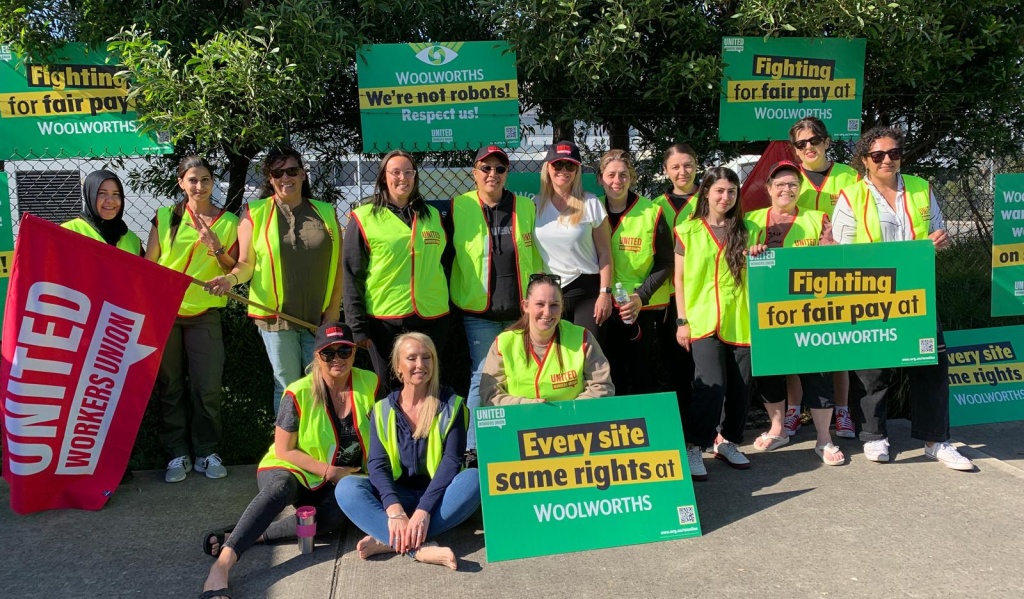
There are also significant risks to the mental health of workers with one worker saying they’re “constantly anxious if I am going to meet the percentage. The depression after working as hard as I could on a job and still not getting the percentage the system thinks i should.”
Despite workers lodging over 2,200 individual disputes earlier this year, Woolworths won’t commit to ending the system.
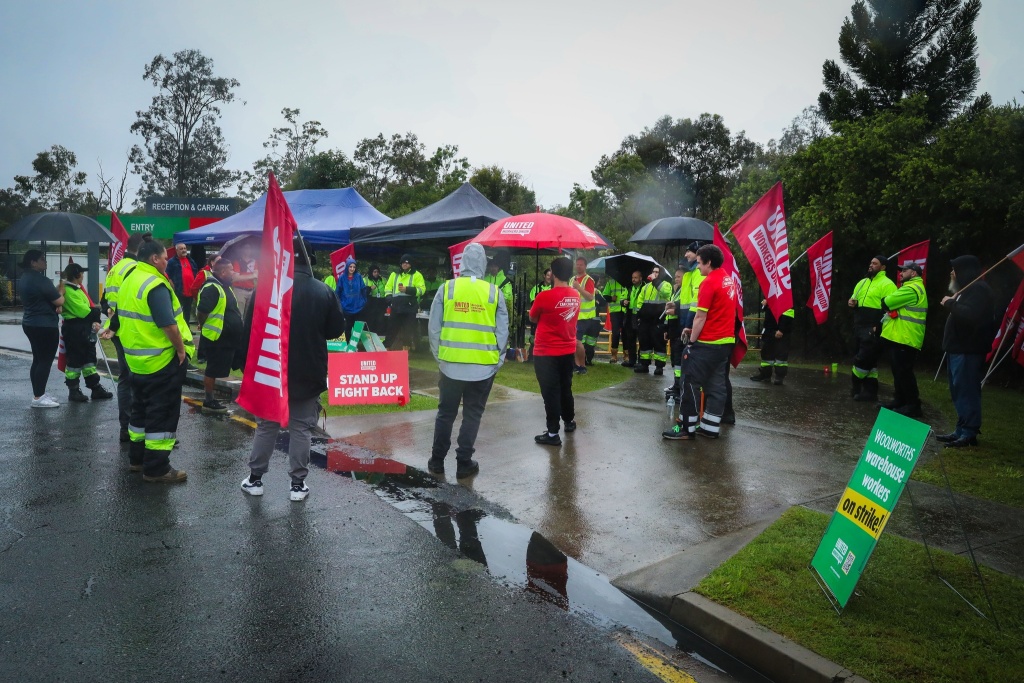
This affects members at Woolworths right now, but if it continues it will set a dangerous precedent for workplace safety in a number of workplaces.
A Sydney Morning Herald columnist asks readers to, “imagine this: you wake up, take a shower, eat some breakfast and head into work. Upon arrival, you don a headset that directs you around a warehouse – where to go, how long it should take you, and how long it actually takes you, every step of the way.
“Your toilet breaks? Tracked. Stopping to tie up your shoelace? Also tracked. Taking the long way around to avoid a broken bottle of pasta sauce or spilt milk? Definitely tracked.
“Come the end of the day, when you’re physically shattered from living in your own real-life version of Pac-Man, you hang up your headset and, as you clock out, a performance score between one and 100 appears on-screen, telling you how perfectly or poorly an algorithm has deemed your efforts to be.”
Now imagine if Woolworths continues using this system and it becomes common practice in other workplaces and industries. It’s not hard to picture similar procedures and levels of surveillance being implemented in industries like cleaning, gaming and hospitality, manufacturing and more.
With employers resorting to these kinds of dehumanising measures to increase productivity and profit, it’s crucial that we continue to stand together in our union to push back. If we show Woolworths that the United Workers Union stands together against their framework, we’re also sending a clear message to other employers who might be considering implementing similar systems.
Show your support for members at Woolworths warehouses here.
Interested in hearing more about this issue? Check out this podcast from The Guardian.
Fighting racism is union business

Far too many United Workers Union members experience racism at work. Here’s a great example of how, by coming together in our union, we can tackle discrimination collectively.
A group of security guards working at the ACT laws courts took action against workplace racism and WON!
The guards experienced racist comments and behaviour from the trainer at their workplace. They tried making complaints to their employer about the trainer separately, but had been brushed aside.
Too often when we try to raise issues like this alone, employers don’t pay attention, or ignore our complaints.
But these guards weren’t going to back down. They got together outside of work to meet with an UWU organiser. Together they compiled their experiences of racism from the trainer in question and filed a collective complaint. They also took the opportunity to elect a delegate, Din Mohammad.
Electing a workplace delegate means you’ll have a union-trained member in your workplace to help deal with these situations. There are workplace laws that give elected delegates rights to deal with workplace issues and to support union members.
The ACT guards made one of their stipulations that they did not want the trainer to be dismissed. Instead, they asked that the trainer be reprimanded and keep his position.
Din explained, “The first thing that came to mind is that racism is happening more or less in every workplace. So, if they were going to move the trainer to another place, he’ll do the same thing again. The issue would remain. We wanted to teach him a lesson, and Wilson management as well, that if they hear about racism in the workplace, they must act properly.”
Din told us that after the members submitted their complaint, “the manager tried to talk to us individually, and asked why we went to the union. He offered us positions at different sites and tried to mitigate the issue without any further hassle. So, we told our organiser and escalated the complaint to HR.”
Trying to separate workers is a typical employer tactic. They know that we’re stronger together! Because these guards stood together in their union, their employer ultimately had no choice but to address the problem.
The trainer was given a final warning. He has since apologised to the guards and, more importantly for members, his behaviour has improved. Din says, “since then he’s behaving well, he’s much better than before.”
“Due to being in the union, we got a strong and positive outcome. I’m feeling really good and feeling strong and the power and unity of being in the union.
“I would advise other members to fight racism and any kind of misconduct at work with your union.”
If you experience racism, or any kind of discrimination at work, talking to your colleagues and banding together is a great way to address it. However, if you don’t have other people you can talk to at work, you can always contact our Member Rights Team for advice. Find the contact details for your state or territory here.

Malcolm Rose - Union for life
Congratulations to Malcolm Rose, recently retired school cleaner and UWU member on being presented with a lifetime membership.
Malcolm started working as a school cleaner and immediately joined our union after being made redundant from the Water Corp as part of the awful Richard Court Liberal Government era.
He bought with him extensive skills and knowledge as he was a bookkeeper by trade. He was also a strong unionist as well as all round great guy.
Malcolm joined the WA Branch executive in 2008, where he usually sat very quietly busily going through financial papers with a fine-tooth comb. When it was called to approve the papers, everyone would turn to Malcolm to see if he had any queries. If he gave the nod of approval, the executive could be sure they’d done a good job.
For those of you who don’t know Malcolm is the father of our political organiser Dom… Dom told us his dad always advised his kids
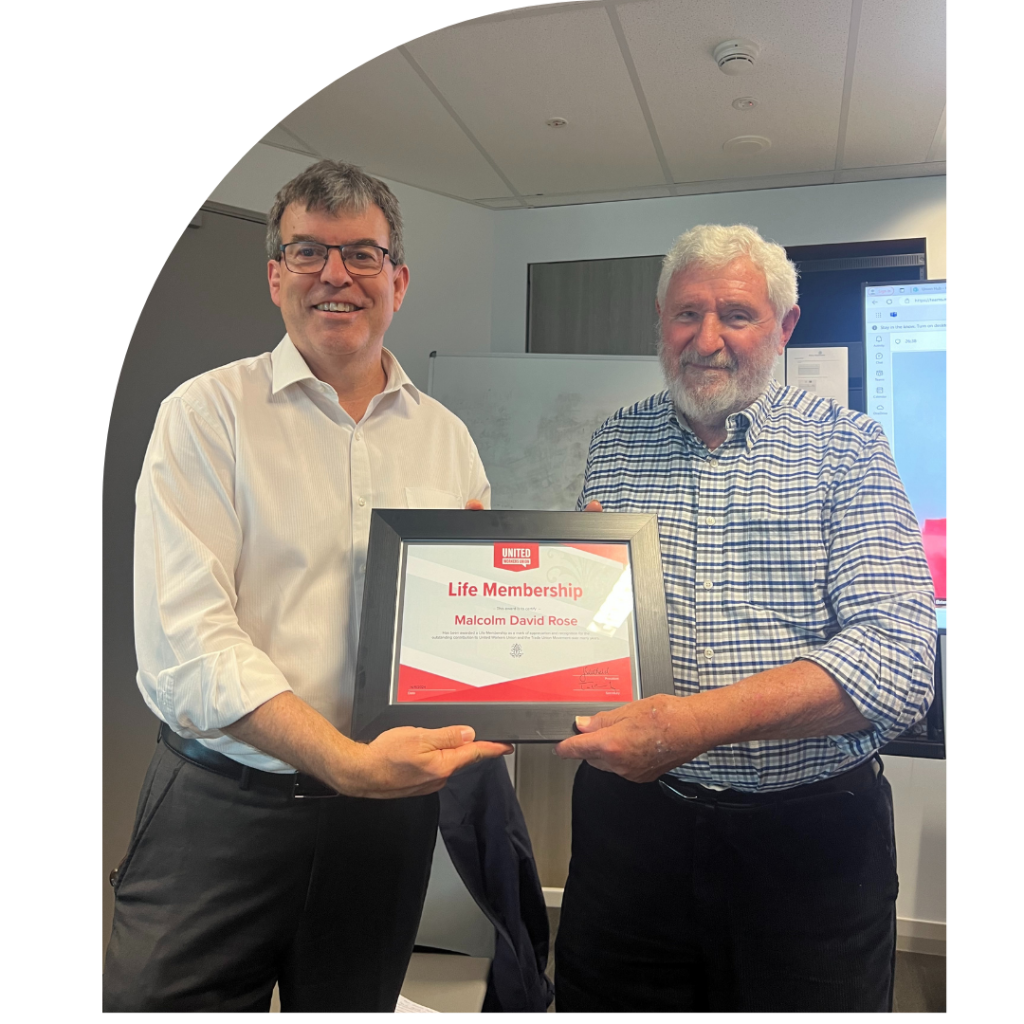
Malcolm is the father of one of UWU’s political organisers, Dom. His advice to his children, “always join your union and get involved, and to take responsibility to look after others,” obviously worked!
Malcolm was a valued member of WA executive and very highly thought of by our education team. His knowledge and wisdom were often sought during bargaining times, he has contributed to significant improvements for school cleaners in WA. Malcolm is now enjoying his retirement.
Thanks Malcolm, for your commitment and contribution to our union. We wish you all the best!
Casual hospitality workers win

Casual hospitality workers at Moonee Valley Racing Club (MVRC) have secured a pay increase and held onto minimum engagement time of three hours in their recent EBA negotiations.
The members, working at five sites across Victoria, stood together and took action to ensure they maintain above-award pay and conditions.
MVRC wanted to reduce minimum shift lengths to two hours, so they could send workers home earlier when it’s quiet on weekends and public holidays, meaning workers lose out on $40-$65 a shift. But members stood firm to maintain their conditions by circulating a petition and speaking to their managers.
Workers at the sites will receive a 9.5% pay increase over three years, and have locked in backpay from 1 August 2024. This ensures their wages will continue to outshine the award.
Congratulations to all members who stood together and took action.
Members Stand Firm at Probiotec Pharma
UWU members at Probiotec Pharma have taken their employer to the Fair Work Commission (FWC) to get the pay increases they negotiated, and they won!
As per their EBA, members were supposed to receive an increase of the higher between 3% and the National Minimum Wage Case decision. However, this has not happened. This goes to show why it’s so important for all of us to be across our agreements and understand our rights.
Members and delegates appeared at FWC hearings and provided statements and evidence to support their case. Their commitment has secured backpay for all workers, and of course, the correct rate moving forward. Congratulations to all members who participated in this victory and who came together to stand up for their rights.