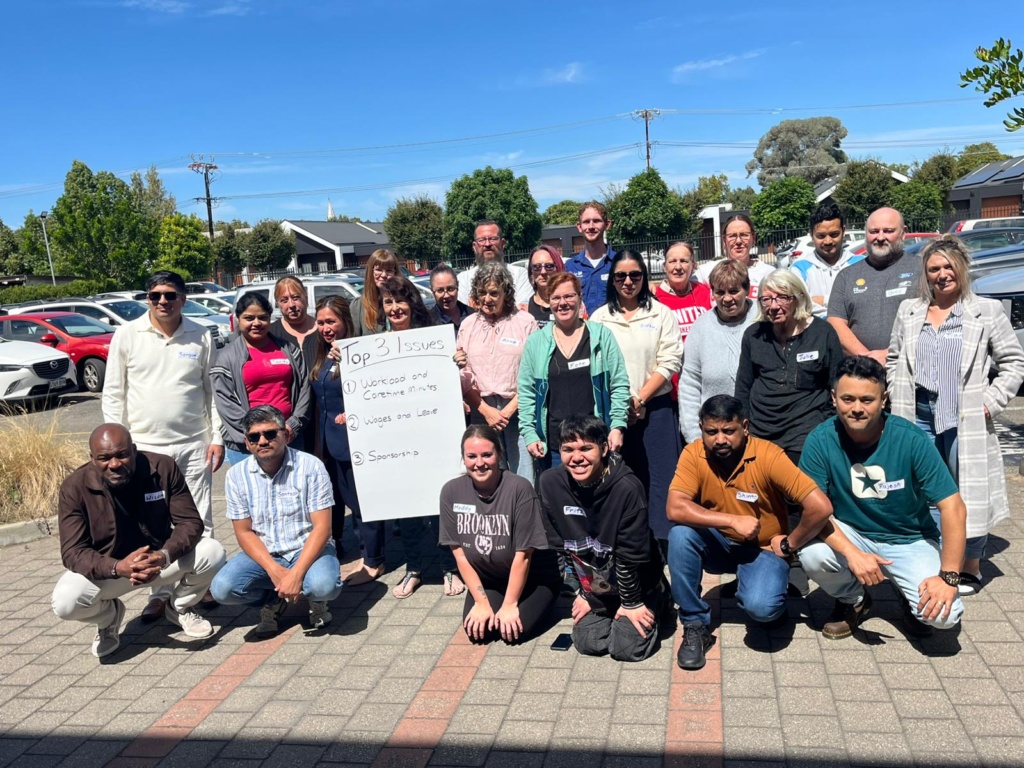


This month we’re hosting THREE member workshops!
These topics were requested by members and are designed to help you at work.
We’re kicking off with resume writing tips to make sure you stand out when applying for jobs. We’ll look at the things you should and shouldn’t include on your resume and the best way to show off your skills and catch the eye of potential employers. Register here.
Next up one of our union’s Member Rights Officers will present about how to address issues with your employer. We know it can be stressful, and that for many, maintaining a good working relationship is important. So, Alex will take us through the best way to raise workplace issues to ensure that the situation doesn’t get out of hand. Register here.
Finally, lots of members said they’d like to learn how to better support their colleagues and be good allies. So we’ve arranged for special guests from Hue: Colour the Conversation to run a workshop to arm members with the information and tools you need to address workplace racism and support your colleagues – being a good ally is what solidarity is all about! Register here.
You can also register now for our May workshop – Tax info for UWU members! We’ll be joined by the Australian National University’s Tax Clinic to help you prepare for tax time. Find out what you can claim on your tax return, the kinds of records you need to keep for tax purposes and more important info about Australia’s tax system.
check your payslips this april!
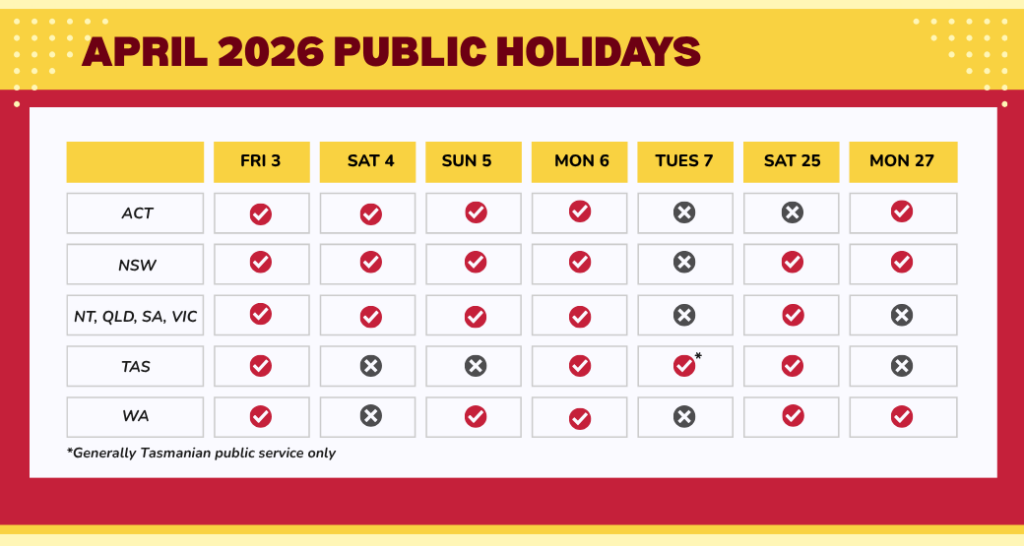
With the upcoming Easter and ANZAC Day holidays, April is a public holiday bonanza! That means it’s an important month to check your pay slips and to be aware of your rights. So, here’s a quick refresher to make sure you’re getting paid correctly.
Permanent full time and part time workers
If any public holiday falls on a day that you would usually work, but you have the day off, whether or not the workplace is closed, you should be paid as usual for that day.
If you work on a public holiday, you should be paid penalty rates or according to conditions laid out in your agreement. For some workers that might mean receiving time off in lieu.
Casual workers
If you don’t work on a public holiday, you are not entitled to pay, even if you ordinarily work that day. If you are working, you should be paid penalty rates.
All workers have the right to NOT work on public holidays. Your employer should ask if you’re available rather than assuming you can work.
Remember to check your pay slip to ensure everything is correct!
Download our pay slip checklist here for more info about what should be on your pay slip and how to understand it.

Here are all the ways UWU members can get help with the rising cost of living
With the war in the Middle East driving up inflation and sending fuel prices soaring, farmers are warning that food prices are likely to increase (even more) too. With workers already struggling with the high cost of living, we know this is the last thing you want to hear.
But don’t despair, there is help available! Check out this list of discounts and offers to help you save money on common household expenses with your union membership.
Compare your energy rates
Cooperative Power is a member owned and run, not-for-profit energy cooperative. With a focus on taking the power back from large for-profit energy companies, CoPower provides competitively priced electricity* and gas** to households across much of Australia. Switch to CoPower today and get $50 off your first bill. If you’re already a CoPower customer member, refer a friend and receive $50 off your next bill.
If you’d like to shop around more, you can also compare your gas and electricity rates through Union Shopper. If you switch both services through the Union Shopper promotion by 30 April, you’ll receive a $140 Mastercard eGift Card ($90 electricity, $50 gas).
Compare your phone and broadband rates
Compare and switch to another broadband provider through Union Shopper in April and receive a $70 Mastercard eGift Card.
And if it’s a while since you compared your mobile bills, check those too. While you do, have a look at Union Shopper’s deals on Member’s Mobile – they’re Australian owned and operated, have no lock-in contracts and allow you to bank unused data.
Car expenses
If you’ve been putting off servicing your car, book a service with MyCar (through Union Shopper) and get a 12.5% discount. Not only does keeping your car serviced save you on repairs in the long run, but it also ensures your car is running economically, saving you money on fuel.
And while you’re online, shop around for a better car insurance offer. Remember to check the deals on Union Shopper regularly; they run occasional promotions to help you save on car insurance. Members have saved $100s thanks to past promotions.
If there’s a “Freedom Fuel” station in your area, make sure you’ve signed up for their special offer that will save you up to 8c a litre on petrol!
Home loan rates
While interest rates are decided by the Reserve Bank, sometimes you can often find better rates to save money on your home loan. Use the free Union Shopper Finance – Mortgage Broking Service to see if there’s a better deal out there for you.
More member benefits
There is a wide range of benefits available to United Workers Union members. Log in to MemberLink to find the full list of deals with codes and links to access them. Plus, there are heaps more discounts on Union Shopper including 4% off Coles and Woolworths gift cards.
If you’re struggling with debt, check out our Cost of Living Hacks workshop on-demand to learn about your rights and get valuable advice. You can also contact the National Debt Helpline for free financial counselling and personalised advice.
Government resources
All state and territory governments have their own lists of rebates, concessions and payments to help with household bills and other essential services. Find these below and check to see if there’s any government assistance you could be claiming.
ACT: https://www.act.gov.au/money-and-tax/cost-of-living-support
NSW: https://www.service.nsw.gov.au/campaign/savings-finder
NT: https://nt.gov.au/community/concessions-and-payments/savings-finder
QLD: https://www.concessionsfinder.services.qld.gov.au/
TAS: https://www.concessions.tas.gov.au/
VIC: https://service.vic.gov.au/find-services/personal/savings-finder/
WA: https://www.wa.gov.au/organisation/department-of-communities/concessions-available-western-australia
*CoPower does not operate in NT, WA or Northern QLD
**CoPower gas currently only available in Vic and NSW
are your skills and capabilities being overlooked?
7 out of 10 employers admitted to excluding job applicants based on age, race, mental illness and disability. You don’t have to disclose personal information just because you’re applying for a new job.
A survey of over 600 businesses by the Australia HR Institute revealed that 7 out of 10 employers exclude job applicants if they are over 55, living with a disability, have a history of mental illness or are First Nations, regardless of their capabilities.

The ABC reported that “twenty-nine per cent [of employers] refused applicants with a long-term illness, while 19 per cent reported excluding applicants with a disability or if they were aged 55 and over.” First Nations peoples were also discriminated against with up to 14 per cent of employers reporting they would not hire on that basis.
It’s illegal for employers to discriminate. They are not allowed to ask about your health conditions. Your personal life is your business, not your employer’s. The recruitment process is required to be fair and objective and based on your skills, experience, and qualifications.
Disability Discrimination Commissioner Rosemary Kayess says we still have a long way to go.
“[The survey] reinforces the fact that we haven’t moved past the assumptions of people with disability being expensive or a burden to employers,” she said.
While we all appreciate when managers and employers display emotional intelligence if you’re struggling for personal or health reasons, you’re not obliged to disclose any details. If a medical certificate is required when applying for leave, flexible work or special equipment, it can also be discreet.
If you think you’ve been discriminated against, whether it’s a new role at your current place of employment or an entirely new role, you should first seek feedback from the employer about why you didn’t receive an interview. If their reasons are not satisfactory, remember you can contact our Member Rights Team for advice about what you can do to be treated fairly.
What can be done?
The Australian Human Rights Commission is calling for a ‘positive duty’ clause in the Disability Discrimination Act that would aim to prevent discrimination in a similar way to the Sex Discrimination Act, where employers would be required to prevent discrimination in the first place, rather than just responding to complaints. Unions campaigned over years for positive duty to prevent sex discrimination and now it’s time to broaden the field to other common forms of discrimination. Learn more in our Workplace Discrimination workshop, free for members.

Australian unions have launched a major new campaign to secure an additional week of annual leave for workers – the first increase in minimum standard for leave since the 1970s.
Australian workers are working long hours, regular extra hours on top of their usual hours that go unpaid. On average, this adds up to about 4.5 weeks extra unpaid work every year. For younger workers, it’s even more extreme. Their unpaid hours stretch to about 6.4 weeks extra each year. Over the past 25 years, the gap between employees’ workloads and their wages has widened. Analysis by the Centre for Future Work calculates that real wages would need to go up by 10 per cent to fill that gap. And we all know how much employers like wage increases!
Long hours going unpaid is not only wrong, it’s bad for our health. So, unions are proposing that workers get more leave entitlements for rest and recovery. This would represent an extra 2 per cent for employers in employment costs, compared to paying much more in overtime or increased wages. Employers and workers would both gain through reduced turnover and lost time due to burnout, injury and stress. Workers in Australia do some of the longest hours and it’s time we caught up. A majority of European countries provide more leave for their citizens than the Australian standard and are some of the most competitive and productive economies in the OECD.
It’s time to change the National Employment Standards to reflect the needs of the modern workforce. An increase from 4 to 5 weeks, and 5 to 6 weeks for regular shift workers, would improve the mental and physical health of workers while providing employers with a more secure, rested and productive workforce.

Vic School Cleaners TAKE action for fair pay and protections
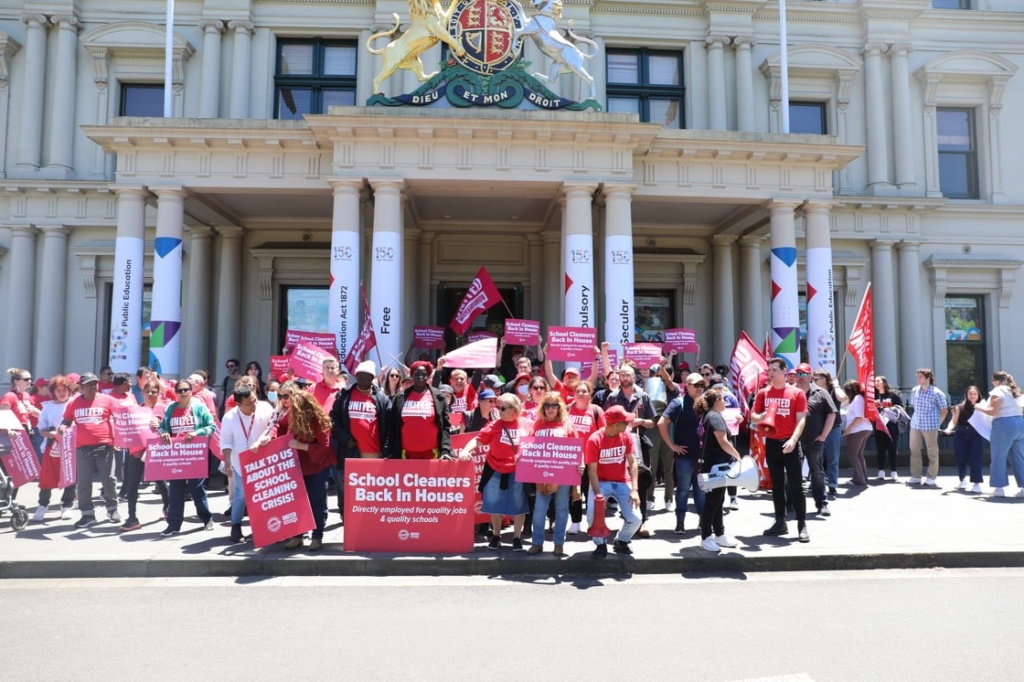
It’s not just teachers who are taking action for fair pay in Victorian schools. Right now, school cleaners in Victoria who work for contractors Menzies and ISS are fighting again for justice, recognition and fair pay.
Bargaining is now underway with the goal of locking in the improved contract conditions of members’ won from the Victorian government in 2023. Since then, the cost of living has gone up, so we have to make sure we see real wage growth to meet living standards, instead of barely keeping up with inflation. On top of this, when contracts end, workers’ pay and conditions often go backwards. Cleaners know too well that often a new contract can mean a pay cut.
Vic cleaners aren’t just asking for fair pay, they’re bargaining for better rights and protections, including specific union rights clauses that allow school cleaners to self-enforce their power in the workplace.
Using multi-employer bargaining as a tool has allowed workers to boost collective power by uniting UWU members across employers to set a new industry standard for a whole sector.
NSW School Cleaner Action Groups uniting members across the state
School cleaners in NSW have come together in action groups to keep moving their campaign forward to bring cleaning jobs back in-house.
These groups meet quarterly to discuss what’s happening in the sector, be updated on current issues on the state of play with the Government and the ongoing discussions to bring all NSW school cleaners in house.
While cleaners in the Hunter and Central Coast NSW have successfully fought for direct employment with the government (a huge win and an end to dodgy contractors), the rest of NSW school cleaners are keeping up pressure on the government to give the same opportunity to the rest of our school cleaners.
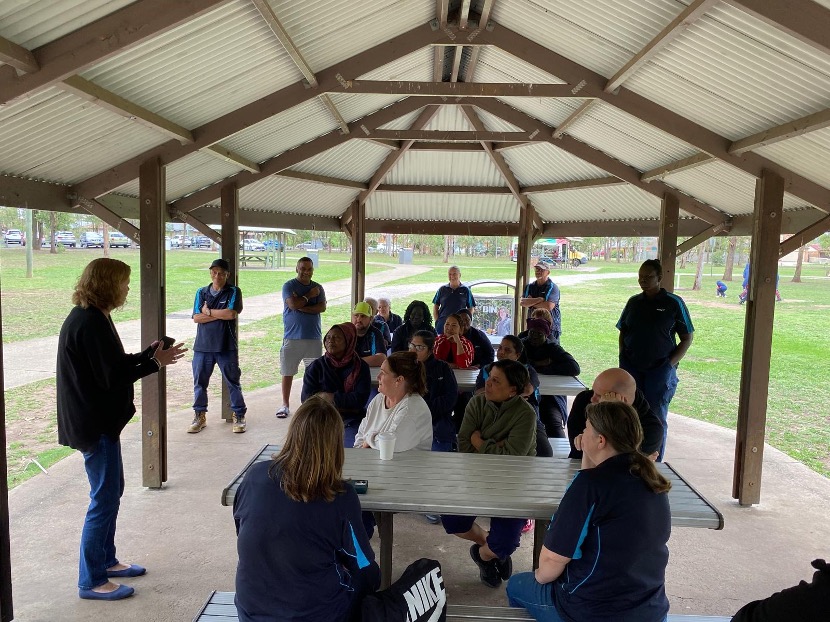
NSW State Secretary Mel Gatfield gave a briefing on the current state of play with the government and the ongoing discussions to bring all NSW cleaners in-house. That means no more dodgy contractors, no more going backwards and better outcomes for school cleaners.
NSW School Cleaner, Nirvana Menon’s message to all NSW school cleaners is: “these action groups are a vital part of keeping members updated and giving us tasks to keep our campaign moving forward. I encourage all school cleaning members to attend the groups when they are in your area.”
If you’re in NSW, contact your local organiser to find out where and when the next action group will be meeting ASAP.
Teacher Aides and School Cleaners experiencing Occupational Violence

Teacher Aides and School Cleaners have been sharing their stories of Occupational Violence and demand the Crisafulli Government puts an end to occupational violence in Queensland schools.
Teacher Aides and School Cleaners across Queensland have faced a huge increase in occupational violence in the past year, according to the United Workers Union report.
The statewide surveyed over 1,200 UWU Teacher Aides and School Cleaners and found:
- 81% of those surveyed has experienced occupational violence during their working careers
- Of those, a staggering 80% or well over half of the workforce, said they had experienced occupational violence within the last school year.
- The majority of those who experienced occupational violence (65%) said they did not feel safe returning to work.
The results of the survey, which received responses from Teacher Aides and School Cleaners from Brisbane to Rockhampton, demonstrate that occupational violence is not a ‘one region’ or ‘one type of school’ problem, but rather a system-wide crisis in Queensland schools.
Errin Roberts, Education Coordinator at the United Workers Union, called out the Crisafulli government’s inaction in addressing occupational violence.
“It’s not right that over half the workforce says they have experienced occupational violence in the last year alone.
“Our members are dealing with multiple children with complex needs in overcrowded classroom settings on low wages. The Crisafulli Government cannot allow the status quo of occupational violence as just being ‘part of the job’ for teacher aides and school cleaners to continue.”
Former Teacher Aide and United Workers Union Member Murphy shared her story of occupational violence and how numerous incidents have impacted her physical and mental health, forcing her to leave the industry.
“Having been a teacher aide now for over 8 years, I have experienced around 30 violent assaults during my career. The physical and psychological toll of these incidents has a compounding effect on your mental health. I have been forced to leave the sector because of occupational violence.”
Debbie Wynne, a long time UWU member and Teacher Aide in Far North Queensland, shared how she had noticed an increase in occupational violence over the past three years.
“I work in a school with 1400 kids, and I am constantly facing a bombardment of abuse, and because they are high school kids, they try and intimidate you. We are burnt out, occupational violence feels like it’s at an all-time high and it has gotten progressively worse in schools over the last 3 years.”
The United Workers Union is calling on the Crisafulli Government to implement practical solutions informed by the experience of Teacher Aides and School Cleaners to address the issue, outlined in United Workers Union’s report.
The proposed reforms aim to shift the Queensland Department of Education’s approach in addressing occupational violence from being reactive, inconsistent, and unsupportive to comprehensively supporting staff when dealing with the outcomes of occupational violence.
To find out more, read United Workers Union’s Occupational Violence report.
airport Security workers CAMPAIGN for respect and fair pay

Currently, security members at Perth airport are paid rates below the standard for aviation screeners.
Security workers at Perth airport have already signed a pledge of support from airport and aviation colleagues and fellow members to campaign in their upcoming EBA.
Their current agreement expired on March 31 and members are fighting for a fair wage in the next agreement. Members are already signing a pledge to fight for parity, because Peth airport security workers shouldn’t be left behind!
Perth Airport security members are already active and prepared, and this is what solidarity and commitment looks like:
- Voting no to any substandard EBA
- Becoming a UWU member (if not already!)
- Speaking with co-workers about supporting the campaign
- Voting YES for industrial action if members decide it’s necessary to win a fair agreement
Security workers keep the public safe, every day they make sure we can fly safely without risks and threats to our safety, it’s time ISS comes to the table and pays workers what they deserve, recognises the critical role they play, respects workers and agrees to an industry standard so workers don’t go backwards.
FIRIES TAKE ACTION AGAINST UNSAFE STAFFING LEVELS AND INADEQUATE RESOURCING
“Firefighters put their lives on the line for the Territory, and they deserve an agreement that respects that, not one that ignores the risks and sacrifices of the job.”
Firefighters face many more risks than the obvious dangers of their job as frontline emergency workers. On top of fighting fires to keep the community safe, they face cancer risks from exposure to smoke among other safety concerns that the NT government has not adequately addressed with their half-baked offer.
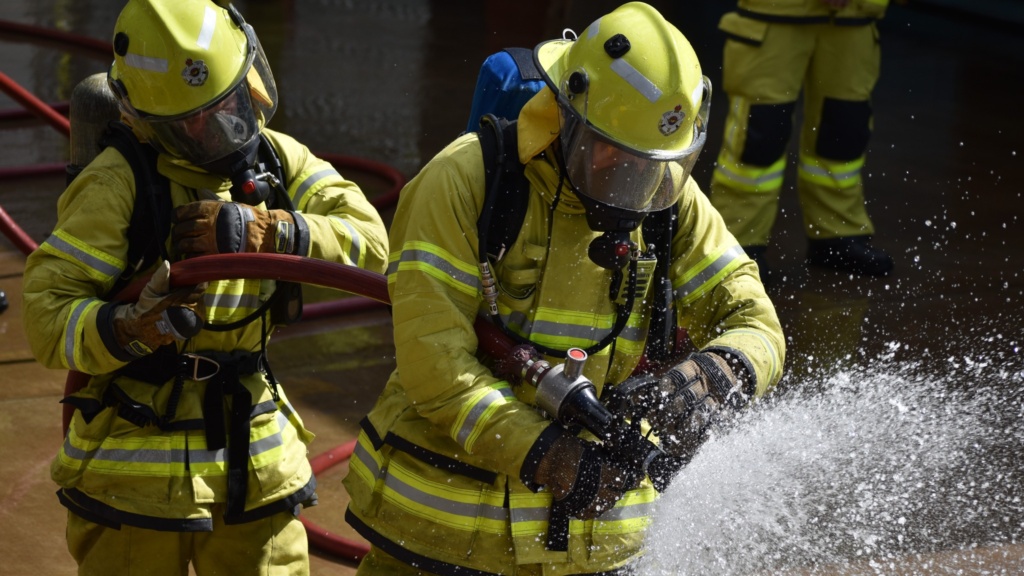
Firies in the Northern Territory are taking action over safety and resourcing in response to the government’s substandard offer. UWU’s NT secretary Erin Early spoke to the NT Independent about the so-called negotiations.
““Putting a substandard agreement to a vote is not negotiation, it’s an attempt to sidestep the issues firefighters have been raising for months. Our firefighters are united, they are angry, and they are determined to fight for a fair deal”
As UWU members, we put safety first. Understaffing and a lack of resources create unsafe working conditions. Our members are demanding:
- Safe shifts need safe crews
- Strong well-resourced fire services
- Fatigue and exhaustion needs to be addressed as a safety issue
Corrections officers strike for 12 hours
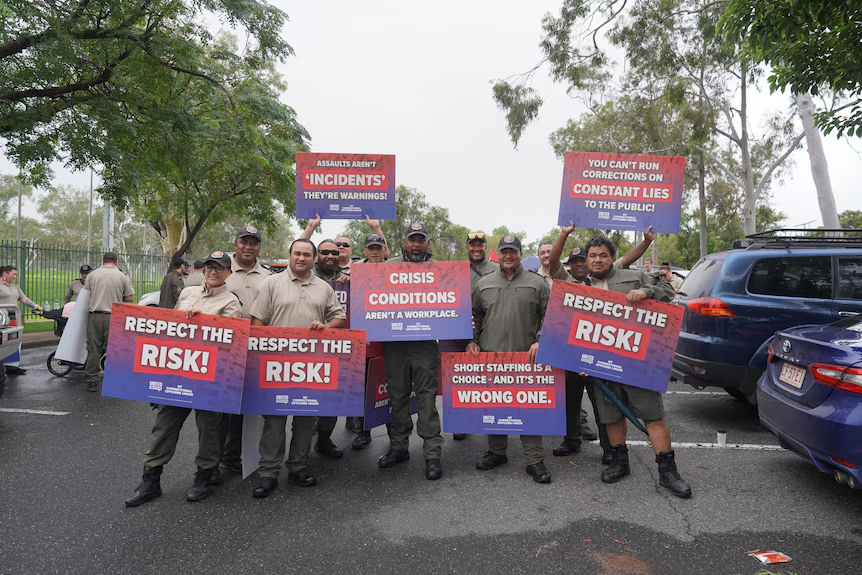
More than 80 guards took to the streets of Alice Springs to take part in industrial action against the NT Government.
Northern Territory Corrections Commissioner Matthew Varley tried to halt the action with a last-minute appeal lodged with Fair Work, but was unsuccessful.
The stop work action went from 8am to 8pm with many members claiming safety issues and understaffing as an even more pressing issue than a much-needed pay rise.
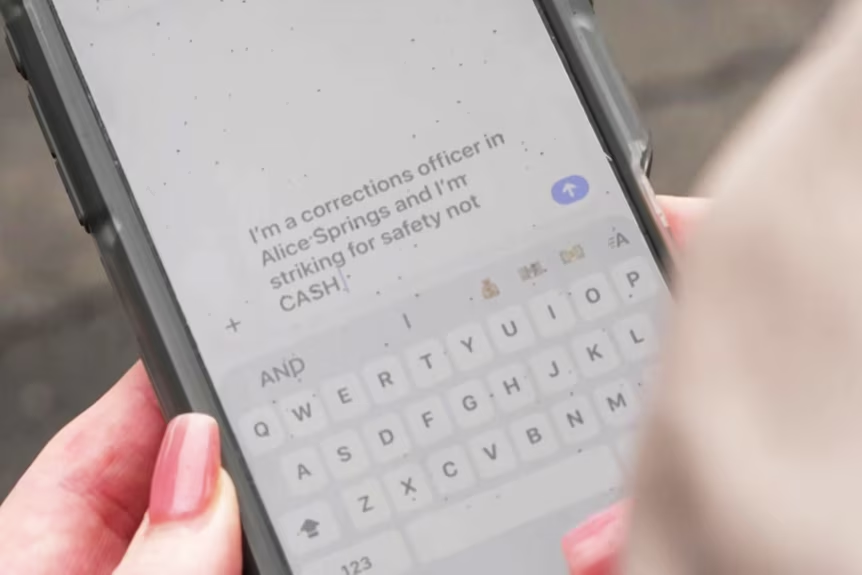
The Corrections Commissioner’s claim that officers were being taken away from emergency flood support as well as putting facilities into lockdown was disingenuous when it’s in the government’s power to create safer working conditions and staffing levels for these workers.
Members took action to combat:
- Overcrowding and understaffing
- The broken corrections system
- Assaults on the job
- Safety on the job
no food security without job security
Australia’s food supply chain faces its most serious external threat in decades from rising fuel prices and impacted global fertiliser trade.
As unrest in the Middle East enters its fourth week, and the Strait of Hormuz remains closed, Australia’s food supply chain faces its most serious external threat in decades.
United Workers Union is calling for an overhaul of industry settings to protect the 2.3 million essential food workers whose jobs underpin our nation’s ability to feed itself.
From farms and meat processing to dairy, bread, beverages and supermarket logistics, these workers – mostly represented by United Workers Union – grow, make and move the food Australia depends on. These are workers who need to be protected and invested in, not left exposed to volatile global supply chains.
United Workers Union Food and Beverages Director Mel Gatfield spoke to ABC Radio about what we can do for our members.
“These workers play a vital role in Australia’s food ecosystem – there is no food security without job security. With a war raging in the Middle East and its effects already hitting Australian supply chains, this issue cannot wait.”
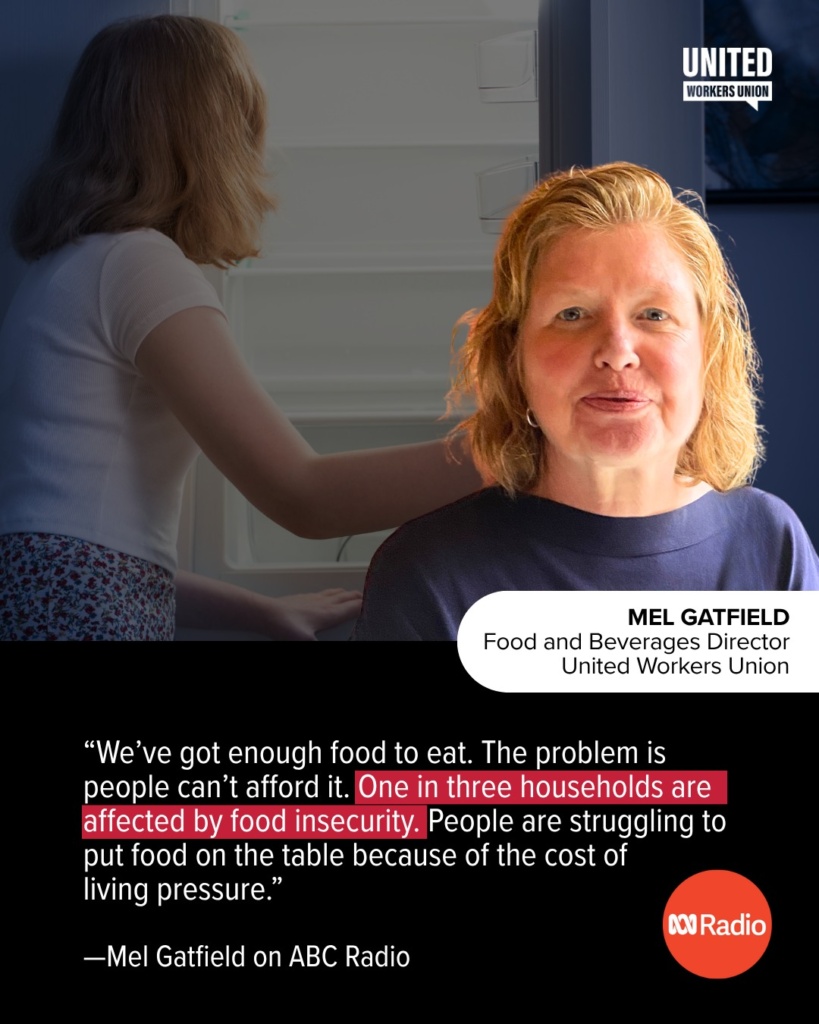
Ms Gatfield was appointed late last year to the National Food Council, which is tasked with advancing food security through the Federal Government’s “Feeding Australia” strategy.
Rising living costs, including higher petrol prices, climate change weather events and global instability driven by the conflict in the Middle East have brought food security to the fore, at a time when vulnerable Australians’ ability to access the food they need is already under pressure.
“The issue of food insecurity affecting Australians right now has come into sharper focus as the broader issue of food security – whether Australia has enough food to feed itself – is made more pressing by global events,” Ms Gatfield said.
“What we’d like to see is a sense of urgency on both fronts: ensuring stable, secure jobs in the broader food sector, and protecting vulnerable Australians from food insecurity.”
UWU’s recommendations to the Inquiry on Food Security in Australia include:
- Investment in the long‑term sustainability of food industries, particularly those impacted by climate change.
- Measures to ease cost‑of‑living pressures and improve access to reliable food infrastructure.
- Secure, skilled employment in regional communities.
- Stronger competition laws to prevent harmful consolidation in critical industries such as dairy.
- Improved protections for migrant workers, including those on temporary visas such as the Working Holiday Maker program, and clearer pathways to permanency.
KMART LYTTON WORKERS WON $40/HR – BECAUSE THEY ORGANISED!
How a super-majority of workers forced Kmart to improve its offer.
Kmart workers at the Lytton Distribution Centre won big with their new agreement locking in the largest Year 1 wage increase in 17 years, with $40/hr for team members. This win increased worker’s annual pay by about $4,465.
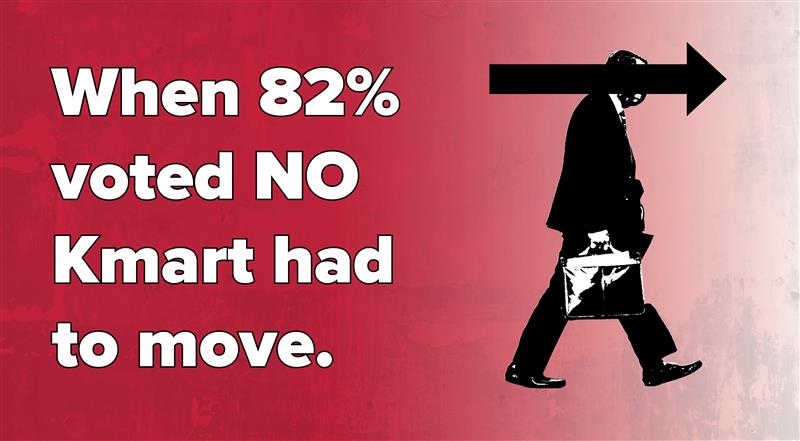
When the first proposed Agreement was put to a vote, a super-majority of workers (82%) voted NO. Workers across the site talked with each other and compared the offer using UWU wage analysis flyers. Together, UWU members decided to demand better.
Historic wage rise
The new Agreement locks in the largest Year 1 wage increase in 17 years! Workers had a credible plan to win and the super-majority NO vote made the risk too great for Kmart to ignore. When 82% voted NO, Kmart had to move.
What else did workers win?
Once workers organised together and forced Kmart to move, the Agreement delivered:
- Training pay rates cannot last longer than 12 months
- Consultation rights before changes to rosters
- Annual leave – managers must respond to leave requests within 28 days
- New Isoloader Allowance
- and more.
These rights are locked in until 31 July 2028.
What’s next?
Do you work at Kmart? You and your co-workers can build from here. The next wins at Kmart will depend on how organised and united workers across the site become. What issues will you and your co-workers decide to organise around next?
Aged care workers organising for change
Hundreds of United Workers Union aged care delegates from across the country came together in March to share frontline experiences, identify the biggest issues facing workers and residents, and plan the next steps for winning change.
These delegates are the backbone of the union in their workplaces – bringing workers together, raising issues and organising for better conditions.
Every improvement in aged care, from pay rises to safer staffing, has been won because workers stood together and took collective action.
But workers know the job isn’t finished, and are continuing to organise to ensure the sector delivers the quality care residents deserve and the fair conditions workers need.
When workers stand together in their union, they have the power to change their workplaces and lift standards across the industry.