

Bullying, harassment or discrimination - what's the difference?

How workplace laws protect you, and what can you do about it?
Workplace bullying, harassment and discrimination can often be confused. They can overlap, but there are key differences in the way they’re defined by the laws that protect workers.
Are you being singled out? Or excluded? Has it happened more than once? Do you get the feeling it’s because of your age, a disability, your religion or race or sexual orientation? Sometimes employers have policies that exclude
If you don’t already know, it’s worth becoming familiar with some of the differences between these behaviours. While the result is similar, in that bullying, harassment and discrimination can all have serious negative impacts on your mental (and sometimes even physical) health, the way we go about fighting back varies. We need to identify the issue before we can tackle it.
Here is an overview, but if you’re experiencing any of these behaviours at work, you should contact your union.
You have a right to safety at work
Mistreatment can come from an employer or a co-worker and this behaviour can be direct or indirect. The harm it causes can be physical or psychological, or both. These behaviours are a risk to your work health and safety, and in some cases to your employment opportunities.
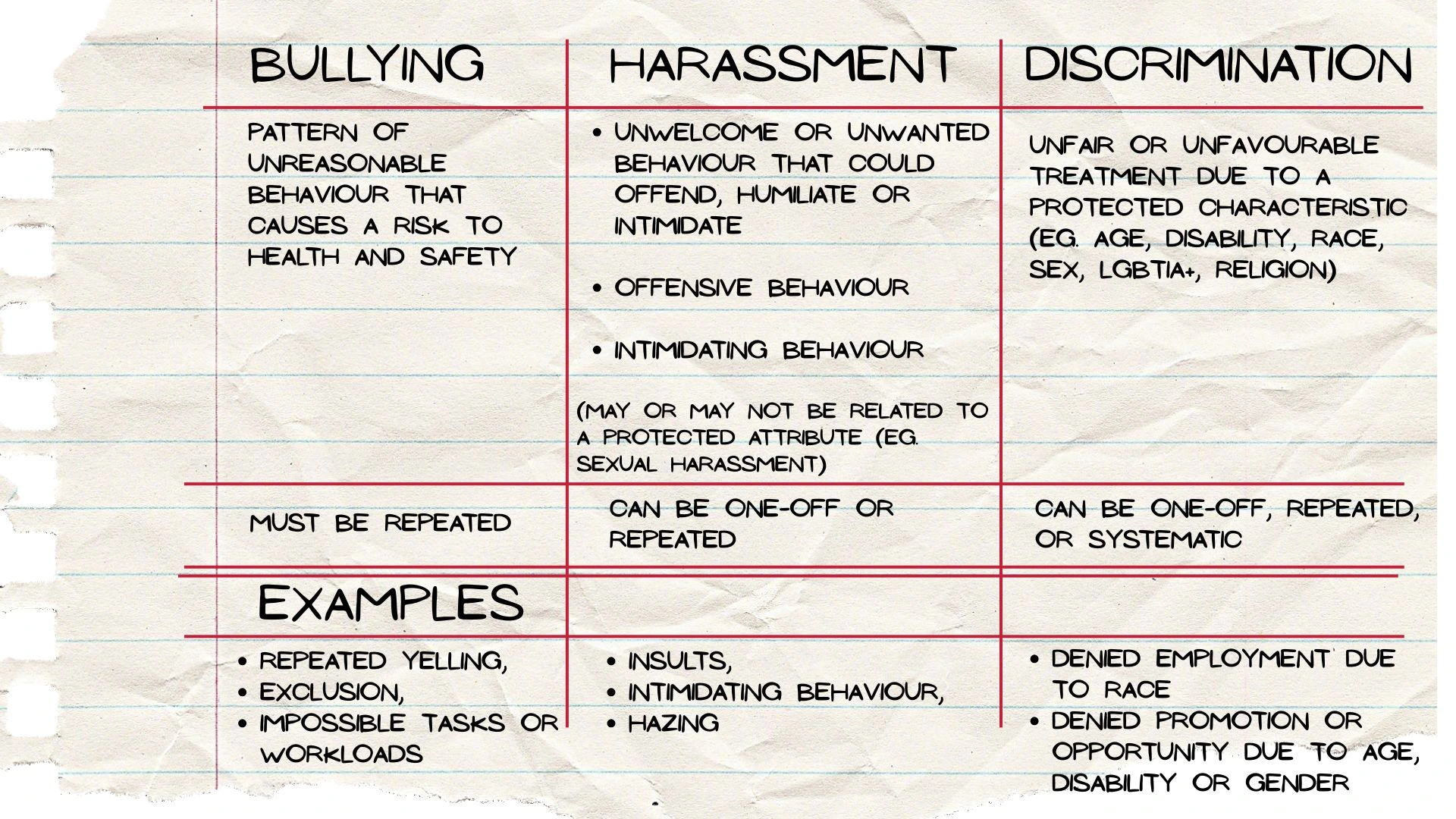
Below is a table of some of the variations that distinguish between these damaging behaviours. As you can see, there is a lot of overlap. Download our Member Assistance Kit if you want to know more. You can use our kit and resources to record relevant experiences that will be helpful if you have to follow up with your union.
Overlap between bullying and harassment
Although bullying requires a pattern of behaviour of unreasonable behaviour, a single incident of unreasonable behaviour could also be classed as harassment if the behaviour is directed at a protected characteristic, such as your race or age. Repeated harassment could also be considered as bullying.
Harassment vs discrimination
Harassment is offensive conduct that makes a person feel uncomfortable or intimidated and unsafe at work. Your employer has a duty to prevent harassment. Harassment that is because of a particular attribute may also be unlawful under discrimination legislation.
Discrimination in employment is where you are treated unfairly or less favourably because of a particular protected attribute and this negatively affects your employment conditions (e.g., losing a job or promotion).
What is NOT bullying?
Reasonable management action carried out in a reasonable manner, such as performance management, or restructuring is not considered bullying.
What are 'protected characteristics'?
Workplace discrimination and harassment are based on specific, legally protected characteristics, including (noting that there are different protections in different states):
- Age
- Race, colour, descent, or national extraction
- Sex, pregnancy, or sexual orientation
- Physical or mental disability
- Religion
- Marital status or family/carer responsibilities
Your employer or co-workers must not discriminate against you or harass you on the basis of these characteristics.
Migrant workers and discrimination
Unfortunately, migrant workers often experience discrimination. A survey by the Migrant Workers Centre found migrant women experienced higher levels of gender discrimination than non-migrant women.
If you want to know more about that discrimination looks like and what you can do about it check out our member workshop, Workplace Discrimination. Our workshops are a resource for members only. If you’re interested but you’re not a member, it’s a good time to join.